Homes priced accurately from day one in Riverside County sell faster and closer to asking price. In Temecula Valley, median days on market ranges from 18 days in Murrieta to 48 in Winchester, and overpriced listings consistently sit longer, lose leverage, and net less at closing.
How does pricing strategy affect how fast a home sells in Riverside County?
A home priced right from day one in Riverside County attracts more buyers, generates stronger offers, and closes faster. Recent local market data shows Murrieta homes are selling in a median of 18 days, while overpriced listings in slower pockets of the county can sit for six weeks or more before sellers are forced into price reductions that signal weakness to buyers.
Key Takeaways
Recent local market data shows a median sale price of $687,500 in Murrieta and $755,000 in Temecula, with Murrieta homes selling in a median of just 18 days.
According to Temecula Now, Temecula's sale-to-list ratio hit 100.1% in April 2026, meaning correctly priced homes are selling at or above asking price.
Days on market vary significantly across Temecula Valley, from 18 days in Murrieta to 48 in Winchester, so area-specific pricing matters more than a county-wide average.
Price reductions after launch signal desperation to buyers and almost always result in a lower final sale price than if the home had been priced correctly on day one.
With 398 active listings and 138 new listings in the last 30 days in the Murrieta area alone, buyers have real choices, overpriced homes get skipped, not negotiated down.
Why does the first week on market matter so much for Riverside County sellers?
The first seven to ten days of a listing are when buyer interest peaks. Buyers who have been watching the market pounce on new inventory. If your price is off, you miss that window entirely, and the longer a home sits, the more buyers wonder what's wrong with it.
This is exactly why I tell sellers that pricing a listing right the first week beats chasing the market down. A price reduction three weeks in doesn't just lower the number, it broadcasts to every active buyer that the seller is under pressure. That shifts negotiating leverage in the wrong direction.
According to Realtor.com's Temecula market page, updated August 30, 2026, homes in Temecula are selling at roughly 100% of asking price on average. That stat only holds for homes that were priced correctly to begin with. Overpriced homes drag the average down after their reductions, and they rarely recover the momentum they lost.
For broader county context, Redfin's Riverside County market data, updated September 3, 2026, shows a county-wide average of 53 days on market. Compare that to Murrieta's 18-day median in recent local data, and you can see how much variance exists across the region. Where your home sits in that range depends heavily on your price.
What the current Temecula Valley market actually looks like
Here's how the major areas in our market are performing right now, based on aggregated public listing data for the trailing 90 days as of September 2026. These are area-level medians, your specific home's value depends on condition, street, build year, and timing.
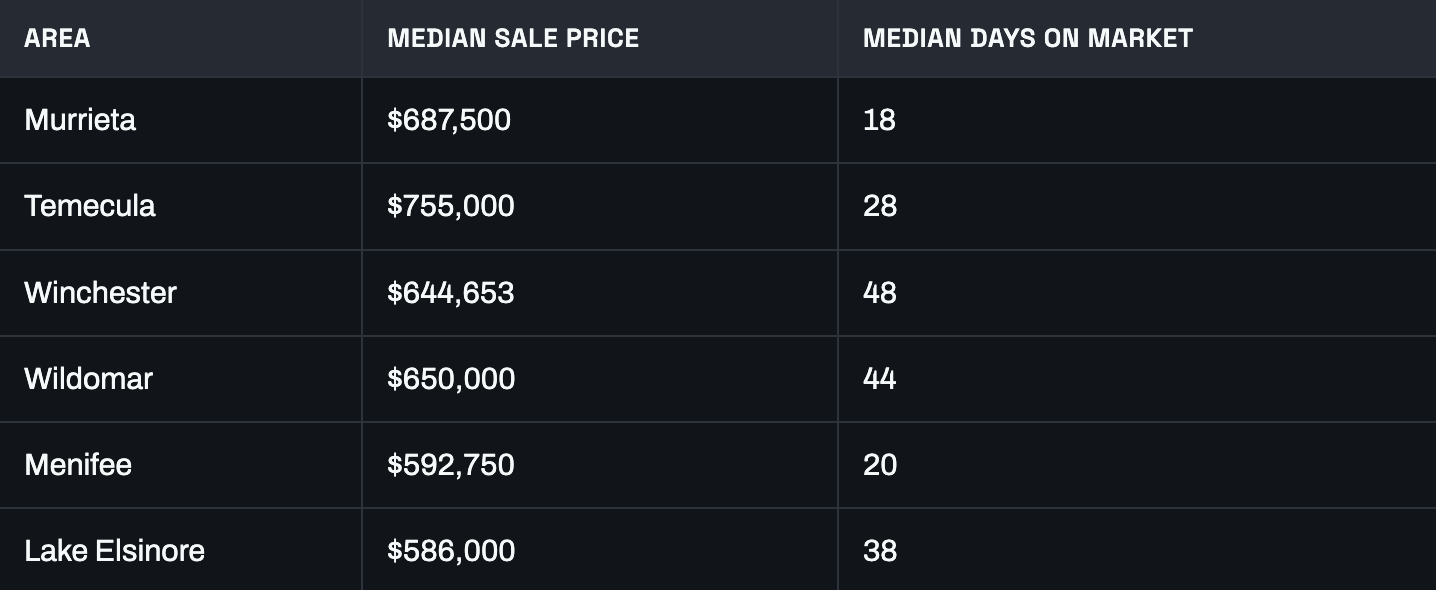
Notice the spread. A seller in Winchester or Wildomar is operating in a slower-moving market than a seller in Murrieta or Menifee. That means the pricing strategy isn't identical across the valley. What works in Murrieta may leave you sitting in Winchester if you don't account for the local absorption rate.
What goes into building a strategic pricing plan for your home?
A strategic pricing plan isn't just pulling a Zestimate and adding 5%. It's a disciplined, data-driven process that looks at what's actually selling, what isn't, and why.
Comparable sales analysis (the foundation)
The core of any pricing plan is a comparative market analysis (CMA) built on recent closed sales of homes that genuinely resemble yours, similar square footage, lot size, age, condition, and location. I weight the most recent sales most heavily because this market can shift in 60 to 90 days. A sale from eight months ago may not reflect what buyers will pay today.
The National Association of REALTORS® research center consistently shows that homes priced within 3% of their eventual sale price from the start close faster and with fewer concessions than homes that require price cuts. That 3% window is tighter than most sellers expect.
Active competition and absorption rate
You're not just competing against past sales, you're competing against every active listing a buyer will see the same weekend they tour your home. With 398 active listings in the Murrieta area and 138 new listings added in the last 30 days alone, buyers have real options. Your price has to make your home the obvious choice at its tier, not the most expensive one in the group.
Absorption rate, how many months it would take to sell all current inventory at the current pace, tells you whether you're in a buyer's or seller's market at your specific price point. A home priced at $750,000 might be in a competitive seller's market while a home at $1.1 million in the same zip code has six months of competing inventory. These are different pricing environments, and they require different strategies. The California Association of REALTORS® market data provides statewide absorption context that I layer against our local numbers.
Condition and presentation adjustments
Two homes with the same square footage on the same street can have a $40,000 to $80,000 price gap based on condition, updates, and curb appeal. A pricing plan has to account for what buyers will see, and what they'll mentally deduct, when they walk through. If you're weighing whether to renovate before listing, I'd point you to this breakdown on renovating before selling in Temecula Valley, some updates move the needle, and some don't.
The CFPB's mortgage resources are also worth a read if you're a seller who's simultaneously buying, understanding what buyers are qualifying for at current rates directly affects what price range has the most active, motivated buyers.
Psychological price points
Buyers search in brackets. A home listed at $705,000 will appear in searches up to $700,000 exactly zero times. A home at $699,900 captures every buyer searching up to $700,000 and every buyer searching up to $750,000. That's not a gimmick, it's how search behavior actually works on every major portal, as NAR's buyer generational trends research has documented for years. Where you land relative to those thresholds can meaningfully affect how many buyers even see your listing.
Should you price below market to trigger a bidding war?
This strategy works in specific conditions, low inventory, high demand, a property with broad appeal. It can backfire if the market doesn't respond with multiple offers, leaving you stuck at a below-market price with a buyer who knows they won. I run this scenario with every seller before we decide, because the right answer depends on your home, your timeline, and what the competition looks like that week. Your specific situation is the only thing that matters here, and that's exactly the kind of analysis a personalized consultation is built for.
If you're also thinking about timing relative to market conditions, this post on whether to sell in a down market or wait covers the timing side of that equation.
What mistakes do overpriced listings make in Riverside County?
I've seen this pattern hundreds of times across Murrieta, Temecula, and the surrounding communities. A seller prices high "to leave room to negotiate." Buyers skip it. The listing sits. The seller drops the price two or three times over six weeks. By the time the price is where it should have been on day one, the listing has accumulated days on market that make every buyer ask, "What's wrong with it?"
The final sale price on a home that went through two price reductions is almost always lower than what the seller would have netted with correct day-one pricing. You don't get the negotiation room you were hoping for, you get a buyer who uses your price history as leverage to push even lower.
Realtor.com's Riverside market data, updated August 31, 2026, shows a median listing price of $739,000 and a median days on market of 49 days across the broader Riverside area. That 49-day average includes a lot of homes that started too high. The sellers who price correctly from the start are the ones pulling that number down toward 18 to 28 days.
The HUD housing data and FHFA House Price Index both track regional price trends that can inform where the market is heading, useful context when you're deciding whether to price for today's market or try to get ahead of it. In most cases, pricing for today's verified data beats speculating on where prices might go.
If you haven't started preparing your home yet, the timeline matters too. This guide on when to start preparing your Temecula home to sell walks through what needs to happen before the sign goes in the ground.
Frequently Asked Questions
How long does it take to sell a house in Temecula right now?
Recent local market data shows Temecula homes are selling at a median of 28 days on market as of September 2026, though this varies by price point and condition. A Temecula Now report from April 2026 cited a median of 25 days, while Realtor.com's August 30, 2026 snapshot listed 52 days for median listing time, the difference reflects how overpriced listings drag the average up. Homes priced correctly from day one consistently land in that lower range.
Is Temecula a buyer's market or seller's market in 2026?
Realtor.com characterizes Temecula as a "warm" market based on its Hotness Index as of August 2026, meaning demand is present but buyers still have choices. With 398 active listings in the broader Murrieta/Temecula area and 138 new listings added in the last 30 days, this is not a frenzied multiple-offer environment for every home, pricing and presentation determine which listings get offers and which sit.
Do overpriced homes sit longer in Riverside County?
Yes, consistently. Redfin's Riverside County market data shows a county-wide average of 53 days on market as of September 3, 2026, but Murrieta's area median is just 18 days, the gap is largely explained by overpriced listings inflating the county average. Homes that require price reductions also tend to close below what correctly-priced homes net, because buyers use the reduction history as negotiating leverage.
What is the sale-to-list ratio in Temecula?
Temecula's sale-to-list ratio was approximately 100% to 100.1% in recent reports, meaning well-priced homes are selling at or very near asking price. Temecula Now reported a 100.1% ratio in April 2026, and Realtor.com's August 2026 data confirmed homes were selling at roughly asking price. This ratio applies to homes priced correctly, overpriced listings that reduce eventually close below their original ask, pulling their individual ratio below 100%.
Should I price below market value to get more offers in Temecula?
Pricing below market to generate multiple offers can work, but it requires the right conditions, low competing inventory, strong buyer demand at your price tier, and a property with broad appeal. In the current Temecula Valley market, where buyers have real choices across 398-plus active listings, this strategy carries more risk than it did in 2021 or 2022. The better approach for most sellers is precise market-value pricing, not an artificial discount, and the right answer depends on your specific home and timing, which is worth working through before you list.
Pricing a home correctly in Riverside County isn't guesswork, it's a disciplined analysis of what's selling, what's sitting, and where your home fits in that picture. Get it right on day one and you're looking at 18 to 28 days to a signed contract in most of our market. Chase the market down with reductions and you'll net less and wait longer.
If you're ready to build a pricing strategy for your home, I'd be glad to run a full comparative market analysis and walk you through exactly where your home should be priced and why. Schedule a consultation with my team at Performance Real Estate and let's put a plan together before your home hits the market.
About Andrew Lewis
Andrew Lewis is a top-producing REALTOR® and founder of Performance Real Estate, serving the Temecula Valley and greater Riverside County. Licensed since 2012, he has closed over 500 transactions totaling more than $200 million in sales, specializing in luxury homes, listings, new construction, relocation, and investor-focused real estate.
Real Broker · (951) 237-0292
Equal Housing Opportunity. Andrew Lewis, CA DRE, Performance Real Estate DRE 01914085 / 02022092, Real Broker, licensed by the California Department of Real Estate. This article is general information only and does not constitute legal, tax, or financial advice; confirm your specific numbers with your closing agent, tax advisor, or lender.