In Temecula Valley, light cosmetic updates, fresh paint, clean flooring, basic landscaping, typically help more than major renovations. Large remodels rarely return their full cost at resale, and unpermitted work creates disclosure and liability risks under California law. The right answer depends on your home's current condition and your timeline.

Should you renovate before selling your Temecula Valley home?
For most Temecula Valley sellers, targeted light updates outperform major renovations before listing. Fresh paint, clean or replaced flooring, and basic landscaping can meaningfully improve buyer perception and move-in readiness without the cost, permit complexity, and timeline risk of a full kitchen or bath remodel. Whether to go further depends on your home's condition, your price point, and how quickly you need to list.
This is one of the first conversations I have with every seller I work with. And the answer is almost never "gut the kitchen" or "do nothing." It's usually something in between, and finding that line is where local market knowledge actually earns its keep.
The renovation decision: what actually moves buyers in Temecula Valley
Let's start with what buyers here care about most: condition and move-in readiness. According to NAR's Profile of Home Buyers and Sellers, buyers nationally place high importance on overall condition and kitchen and bathroom quality, and that tracks with what I see in Temecula, Murrieta, and the surrounding communities every day.
What buyers are generally not paying a premium for: highly personalized finishes, luxury additions, or improvements that reflect your taste more than theirs. The NAR Remodeling Impact Report consistently shows that large, expensive additions are less likely to return their full cost at resale, and that's national data, not Temecula-specific, but it matches what I see in this market.
Light updates that tend to matter
These are the categories I walk my sellers through first, because they move the needle without blowing up the timeline or budget:
Interior paint in neutral colors. One of the highest-impact, lowest-cost moves you can make. Dated or bold wall colors are an immediate distraction for buyers walking through a home.
Carpet replacement or professional cleaning. Worn or stained carpet reads as deferred maintenance. Replacing it with a neutral mid-grade option is often worth it. Cleaning is even better if the carpet is in decent shape.
Basic landscaping cleanup. Weeding, fresh mulch, trimmed shrubs, and a clean driveway matter more than people expect. First impressions start at the curb.
Fixture and hardware updates. Swapping out dated brass fixtures, cabinet pulls, or light fixtures is low-cost and makes a home feel more current without touching anything structural.
Deferred maintenance items. Obvious issues, a clearly worn roof, visible plumbing leaks, significant pest damage, tend to come up in inspection and give buyers leverage in negotiations. Addressing them before listing is often smarter than negotiating a credit after the fact. The California Association of REALTORS® is clear that known material defects must be disclosed; fixing them early removes that conversation entirely.
For a deeper look at one of the most impactful low-cost updates, check out my post on easy and inexpensive bathroom updates you can make before selling, a lot of those apply directly to Temecula Valley homes.
Renovations that usually aren't worth the spend before listing
Here's where I have to be honest with sellers, even when it's not what they want to hear. These categories tend to cost more than they return, especially on a compressed pre-listing timeline:
Full kitchen or bath remodels. Partial updates (new hardware, paint, a new faucet) are fine. Gutting and rebuilding rarely pencils out when you're selling in weeks, not years.
Room additions or new square footage. These trigger permitting, inspections, potential supplemental tax assessments from the Riverside County Assessor, and full code-compliance reviews. The timeline alone makes them impractical before listing.
Highly custom or luxury upgrades. An elaborate outdoor kitchen, custom built-ins, or a high-end home theater reflects your taste, not necessarily what the next buyer wants to pay for.
Major structural reconfigurations. Moving load-bearing walls or relocating kitchens and baths triggers full code compliance review under California's Title 24 Energy Code and the California Building Standards Code, which can significantly increase scope and cost compared to leaving grandfathered conditions alone.
My general rule: if the renovation requires a permit and can't be completed cleanly before listing photos, it's probably not worth starting.
Permits, disclosures, and the risks of skipping them
This is where the "just do it quick" approach can really backfire. California sellers of residential property are required to complete the Transfer Disclosure Statement (TDS) under California Civil Code §§1102–1102.17, which requires disclosure of known material defects, including whether additions or alterations were made without required permits.
Unpermitted work doesn't just create a disclosure headache. It can:
Prompt buyers to request corrections or credits during escrow
Cause appraisers to flag quality or safety concerns
Expose you to post-closing liability if something goes wrong with the work
Result in orders to correct or fines from local building departments, according to the California Contractors State License Board
Inside Temecula city limits, permits and inspections go through the City of Temecula Building and Safety Department. For properties in unincorporated areas of the valley, parts of Wine Country, French Valley, and other communities, permitting runs through Riverside County. Knowing which jurisdiction your property falls under matters, and I always confirm that from the tax bill or GIS before advising a seller on scope.
If you're considering any renovation beyond cosmetic work, use a licensed contractor. The CSLB offers a public license checker where you can verify any contractor's license status and complaint history before you hire them. I check this routinely before recommending anyone to my clients.
Wildfire zones and exterior work
Temecula Valley includes wildfire hazard and high-wind areas, particularly near Wine Country and hillside neighborhoods. The California Department of Forestry and Fire Protection (CAL FIRE) designates these zones, and buyers in those areas often scrutinize roofing, exterior materials, and defensible-space landscaping closely.
If your property is in one of these zones, maintaining vegetation near structures and addressing obvious roofing or exterior maintenance issues before listing is worth prioritizing. Quick fixes that don't meet fire-resistance or wind-load standards can create more problems than they solve once a buyer's inspector gets involved.
HOA approvals: don't skip this step
A significant number of Temecula Valley homes are in HOA communities. Many exterior and structural changes require architectural review and approval before work begins, and HOA review timelines can run from a couple of weeks to a full month or more, depending on board meeting schedules.
Unapproved changes can result in fines or violation letters that may need to be resolved before closing. If you're close to listing, I typically recommend focusing on interior updates and anything that doesn't require HOA sign-off, or getting that approval in place early. This is exactly the kind of pre-listing logistics issue that a game plan up front prevents from becoming a closing-day problem.
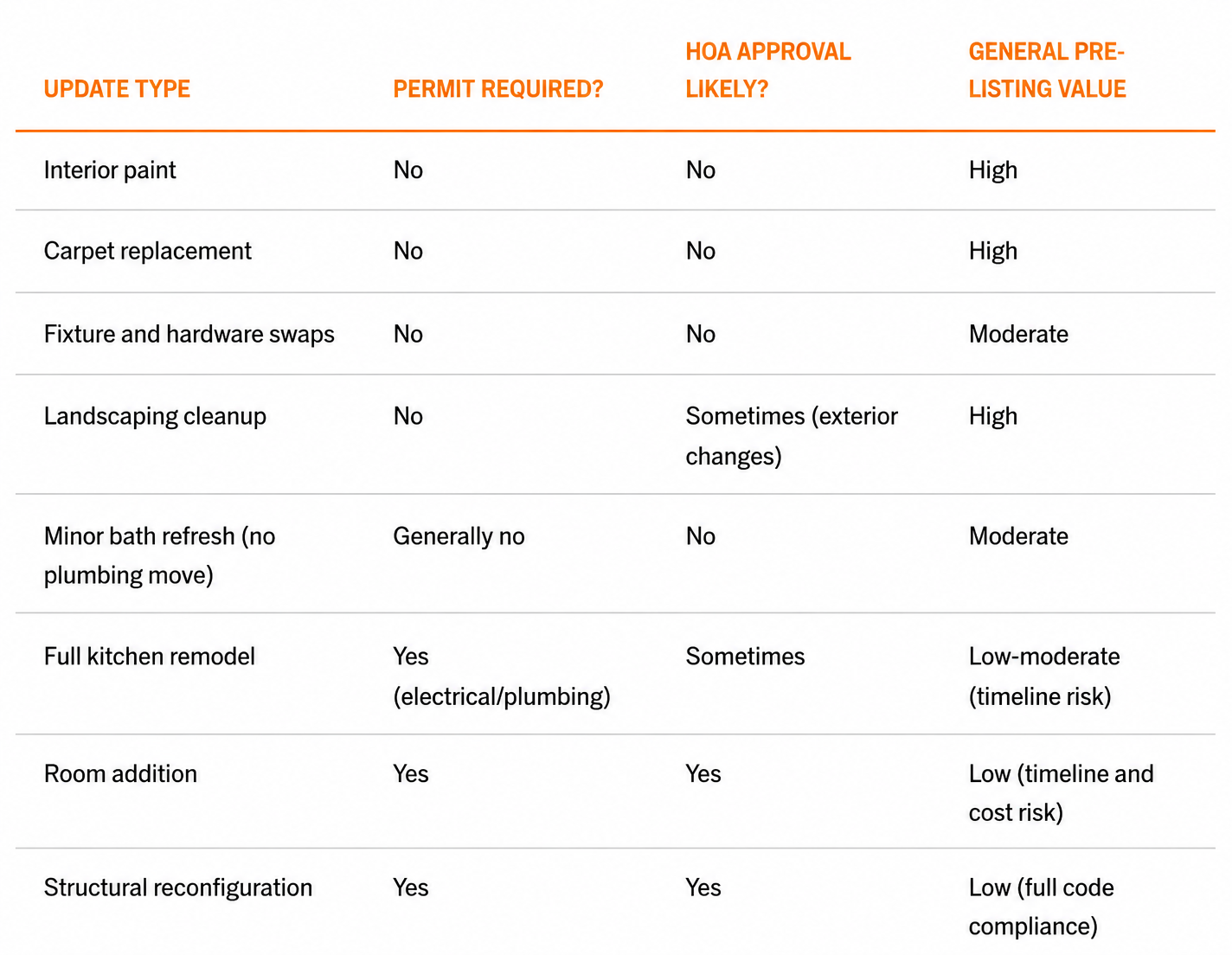
Note: Permit and HOA requirements vary by jurisdiction and community. Confirm with the City of Temecula, Riverside County, or your HOA before starting any work. This table reflects general practice, not legal advice.
Sell as-is, light updates, or targeted improvements: how to decide
Here's the framework I use with my own sellers. It comes down to three things: condition, price point, and timeline.
Sell as-is makes sense when the home is already in solid condition, you're priced to reflect it, and the buyer pool in your segment is comfortable doing their own updates. Investors and move-up buyers in certain price ranges are often fine with this. Pricing it right from day one is non-negotiable here, in our market, chasing the price down after a stale listing costs more than any cosmetic update would have.
Light cosmetic updates are the sweet spot for most sellers. You're not taking on permit risk or blowing your timeline, but you're presenting a home that shows well and feels move-in ready. This is where paint, flooring, fixtures, and landscaping earn their keep.
Targeted improvements, addressing specific deferred maintenance or known inspection issues, make sense when you know a problem exists that will surface in inspection and give buyers leverage. Fixing it proactively keeps the deal cleaner and usually costs less than a post-inspection credit.
Your specific situation depends on your home's condition, its location within the valley, and what buyers in your price range expect. That's a conversation worth having before you spend a dollar on anything, or decide not to.
Frequently Asked Questions
Is it better to sell my Temecula house as-is or do some cosmetic updates first?
It depends on your home's current condition and your timeline. For most sellers, targeted cosmetic updates, paint, flooring, basic landscaping, improve buyer perception enough to justify the cost without the risk of a major renovation. Selling as-is can work well when you price it accurately to reflect the condition. The key is not letting the listing go stale while you try to recoup more than the market will give you.
Which pre-listing fixes really matter to buyers in Temecula Valley?
Fresh interior paint in neutral colors, clean or replaced carpet, basic landscaping, and updated fixtures consistently make the strongest impression on buyers. Deferred maintenance items, visible roof wear, plumbing leaks, pest damage, matter even more because they show up in inspection reports and give buyers negotiating leverage. According to NAR's buyer research, move-in readiness and overall condition rank at the top of buyer priorities nationally, and that holds true in this market.
Do I need permits to update my kitchen or bathrooms before selling my Temecula home?
Cosmetic work, new cabinet hardware, paint, a faucet swap, generally doesn't require a permit. But any work touching electrical, plumbing, or structural elements typically does, whether you're inside Temecula city limits (handled by the City of Temecula Building and Safety Department) or in unincorporated areas (handled by Riverside County). When in doubt, check before you start, unpermitted work must be disclosed on the Transfer Disclosure Statement and can complicate your sale.
Will unpermitted work make it harder to sell my house in Temecula or cause problems with disclosures?
Yes, it can. California sellers are required under Civil Code §§1102–1102.17 to disclose known material defects, including unpermitted additions or alterations. Buyers and their inspectors often spot work that doesn't match permits, which can trigger requests for corrections, appraisal flags, or post-closing liability. The California Contractors State License Board also warns that unpermitted work can lead to orders to correct or fines, making it a real risk for last-minute pre-sale renovations.
Can major renovations right before selling change my property tax assessment in Riverside County?
Major new construction or additions can trigger a supplemental assessment by the Riverside County Assessor, potentially increasing your assessed value beyond normal Proposition 13 limits. This can happen when the work is completed and reported, not just at sale. Cosmetic work that doesn't expand square footage or alter the structure, paint, flooring, cabinets in the original layout, typically does not trigger a new assessment, according to the California State Board of Equalization.
What are the risks of hiring an unlicensed contractor for last-minute renovations on my Temecula property?
The risks are significant. The California Contractors State License Board warns that unlicensed work can lead to orders to correct, fines, and difficulty selling. Improper work can also create future liability and complicate insurance claims. For anything beyond minor cosmetic work, always verify a contractor's license status through the CSLB's public lookup before hiring, and get a written contract specifying scope and timeline.
Every situation is different, and the only way to know which updates will actually move the needle on your specific home is to walk through it with someone who knows this market. That's exactly what I do before we ever set a list price.
Ready to figure out the right pre-listing strategy for your home? Schedule a consultation with Andrew and we'll build a plan that fits your timeline, your home's condition, and what buyers in your price range are actually looking for right now.
About Andrew Lewis
Andrew Lewis is a top-producing REALTOR® and founder of Performance Real Estate serving the Temecula Valley and greater Riverside County. Licensed since 2012, he has closed over 500 transactions totaling more than $200 million in sales, specializing in luxury homes, listings, new construction, relocation, and investor-focused real estate.
Real Broker · (951) 237-0292
Equal Housing Opportunity. Andrew Lewis, CA DRE, Performance Real Estate DRE 01914085 / 02022092, Real Broker, regulated by the California Department of Real Estate. This article is general information only and is not legal, tax, or financial advice. Confirm your specific situation with your attorney, tax advisor, lender, or escrow officer before making any decisions.