A 1031 exchange defers federal tax on gain when you sell investment real estate and reinvest in like-kind property. You must identify replacement property in writing within 45 days, close within 180 days, and route proceeds through a qualified intermediary. It defers tax rather than eliminating it, and cash you receive can be taxable.

1031 Exchange for Property Investments in Temecula Valley
How does a 1031 exchange for property investments work in Temecula Valley?
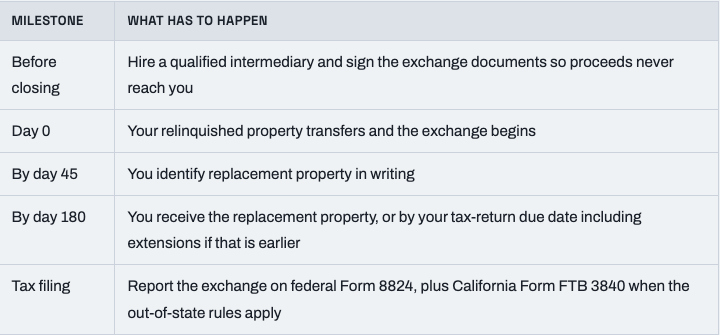
A 1031 exchange for property investments lets you defer federal tax on the gain when you sell an investment property and reinvest in qualifying like-kind real property. You have 45 days to identify the replacement in writing and 180 days to close on it, and your sale proceeds have to stay with a qualified intermediary, never in your own account. It defers the tax bill; it does not erase it.
Key Takeaways
In a deferred exchange, you must identify replacement property in writing within 45 days and receive it within 180 days of transferring the property you sold, or by your tax-return due date if that comes first.
Recent local market data shows a Murrieta median sale price of $670,000 with 418 active listings, so there is real inventory to search while your 45-day clock runs.
Section 1031 generally defers tax rather than eliminating it, and any cash or other non-like-kind property you receive can be taxable up to that amount.
Only real property held for business or investment qualifies, so a property you bought primarily to renovate and resell generally does not.
If you trade a Temecula property for property outside California, California can require you to file Form FTB 3840 every year until the deferred California-source gain is recognized.
What are the 1031 exchange rules and deadlines investors must follow?
Two clocks start the day your sale closes: 45 days to identify what you're buying and 180 days to finish buying it. Both are firm, and the IRS describes them in its guidance on like-kind exchanges under Section 1031.
I walk my clients through this calendar before a listing ever goes live, because the deadlines don't bend for a slow escrow or a tight market. I also broke down the full sequence in How a 1031 Exchange Works for Temecula Valley Investors.
Why do you need a qualified intermediary?
You need one because you generally cannot take actual or constructive receipt of the sale proceeds and still have a deferred exchange. The proceeds are ordinarily held by a qualified intermediary under an exchange agreement, as the IRS explains.
The exchange has to be structured before your sale closes. Lining up the intermediary before you list leaves nothing to scramble over once an offer comes in. Your closing agent will coordinate with the intermediary on the sale side, so tell them early.
What is boot, and how does it create tax?
Boot is cash or other non-like-kind property you receive in the exchange, and gain is generally recognized up to the amount of it, per the IRS real estate tax tips for like-kind exchanges. If you want to pull some cash out, you can, but that portion can be taxed. Debt relief can also produce taxable gain. Your final result depends on your basis, liabilities, and depreciation, which is a conversation for your tax advisor.
Which replacement properties work for a 1031 exchange for property investments near Temecula?
Most real property held for business or investment can work, and it does not have to match what you sold. The IRS notes that rental housing, commercial property, land, and other investment real property can potentially be exchanged for one another when the statutory requirements are met, as laid out in its like-kind exchange tips.
In practice, a Temecula rental home could be exchanged for another rental, a multifamily building, a commercial property, or rural investment land. What matters is the investment or business use of both properties, not their physical type. Since the Tax Cuts and Jobs Act, the federal rule covers real property only, not equipment, vehicles, or other personal property.
How much inventory is there to choose from?
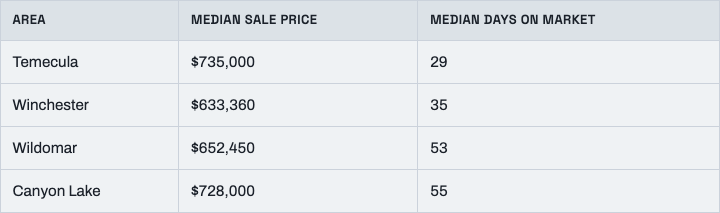
Enough that a disciplined search can fit inside 45 days. Recent local market data (as of October 2026) shows Murrieta with 418 active listings, 143 new listings in the last 30 days, and 420 homes sold over roughly the last 90 days. The median sale price was $670,000, and homes that sold had a median of 30 days on market. Those are area-level figures, and any individual property depends on its condition, street, build year, and timing.
Here is how several nearby areas compare on the same measures:
If you're weighing where to redeploy, my overview of investing in Riverside County real estate in 2026 and the Menifee investment opportunities post are good places to start. For something different, the Canyon Lake waterfront investment guide covers a very different asset type.
Does a property you renovated or plan to flip qualify?
Generally no. Property held primarily for sale, such as dealer inventory or a flip, is outside Section 1031 treatment according to the IRS. If a property has been a true rental, keep the records that show it: leases, operating statements, financing documents, and how you've treated it on your returns. Those are the facts your tax advisor will want in hand.
What California rules and mistakes can derail a 1031 exchange?
The biggest problems I see are missed deadlines, proceeds that touch the investor's account, and out-of-state replacements where California reporting gets overlooked. All of them are avoidable with a plan before you sell. If you need a personal read on your numbers, that's where a conversation with me, your tax advisor, and your intermediary together pays off.
What changes if you buy outside California?
You take on an ongoing filing obligation. When California property is exchanged for property outside the state and California-source gain remains deferred, you generally must file Form FTB 3840 for the exchange year and for later years until that gain is recognized. The California Franchise Tax Board explains the requirement on its page for reporting like-kind exchanges. California also limits its like-kind treatment to real property, matching the federal rule, as that same FTB guidance states.
How does California withholding apply?
Qualifying simultaneous exchanges are exempt from withholding at the transfer, and a qualifying deferred exchange is generally exempt at the initial transfer. Special rules apply if you receive cash or other property in addition to the exchange property, and an intermediary can have withholding obligations if the exchange fails. The details are in the FTB's Form 593 instructions. Confirm your specific situation with your closing agent and tax advisor before closing, because the conditions are detailed.
Why does ownership structure matter?
The person or entity that sells the relinquished property should be the same taxpayer that acquires the replacement. A last-minute change, such as moving title into a different LLC or adding a partner, can jeopardize exchange treatment. If your property is held in a partnership, trust, or LLC, get professional advice on structure before you list.
FAQ
Can I use a 1031 exchange to move from a Temecula rental into a Murrieta or Menifee investment property?
Yes, if both properties are real property held for investment or business use. The exchange rules are federal and apply statewide, so moving between Temecula, Murrieta, and Menifee doesn't change the analysis. The replacement still has to be identified within 45 days and received within 180.
Does the replacement property have to be another single-family rental?
No. Like-kind is broad for real estate, so a single-family rental can potentially be exchanged for multifamily, commercial, land, or other qualifying investment property. Both properties must meet the investment or business-use requirement.
What happens if I miss the 45-day identification deadline?
You generally lose the deferred-exchange treatment, and the gain can become taxable in the year of the sale. The IRS requires written identification within 45 days, and the deadline is not extended for market conditions. Talk to your tax advisor right away if you're at risk of missing it.
Can I identify more than one replacement property?
Yes, you can identify more than one in writing, but identification rules limit how many properties you can name and how they are valued. Your qualified intermediary and tax advisor can confirm exactly how those limits apply to your exchange before you submit your list.
What happens if I receive cash from the exchange?
That cash is boot, and gain is generally taxable up to the amount you receive. The remaining gain can still be deferred if the exchange otherwise qualifies. Plan any cash you want to take out with your tax advisor before closing.
A 1031 exchange for property investments rewards the investor who plans before the sale, not after. Run the calendar, line up your intermediary, and know where your replacement search will start. If you're thinking about selling a Temecula Valley investment property, I'd like to walk through the plan with you, and you can schedule a consultation to get started.
About Andrew Lewis
Andrew Lewis is a top-producing REALTOR® and founder of Performance Real Estate serving the Temecula Valley and greater Riverside County. Licensed since 2012, he has closed over 500 transactions totaling more than $200 million in sales, specializing in luxury homes, listings, new construction, relocation, and investor-focused real estate.
Real Broker · (951) 237-0292
Equal Housing Opportunity. Performance Real Estate DRE 01914085 / 02022092, Real Broker. Regulated by the California Department of Real Estate. This article is general information, not legal, tax, or financial advice; confirm your own numbers with your closing agent, tax advisor, or lender.