A 1031 exchange lets Temecula Valley investors defer capital gains taxes by reinvesting sale proceeds into like-kind real property. You must identify a replacement property within 45 days and close within 180 days, use a qualified intermediary to hold funds, and file Form 8824 federally plus Form FTB 3840 if you exchange out of California.

How does a 1031 exchange work for Temecula Valley investors?
A 1031 exchange lets you sell an investment property in Temecula Valley and roll the proceeds into a like-kind replacement property without paying capital gains taxes in the year of the sale. Under 26 U.S. Code §1031, no gain or loss is recognized when you exchange real property held for investment or business use for other like-kind real property held for the same purpose. You must identify a replacement property within 45 days of closing your relinquished property, complete the acquisition within 180 days, and use a qualified intermediary to hold your proceeds throughout the process.
Key Takeaways
Recent local market data shows the Temecula median sale price at $755,000 with homes selling in a median of 28 days, giving investors a reasonably active market in which to time both the sale and replacement-property search within the 45-day window.
The 45-day identification deadline and 180-day closing deadline are absolute under IRC §1031, missing either one disqualifies the entire exchange and triggers immediate capital gains recognition.
You must engage a qualified intermediary before your relinquished property closes; once proceeds touch your hands, the exchange fails under constructive-receipt rules.
California generally conforms to federal 1031 rules, but if you exchange a Temecula property for one outside California, you must file Form FTB 3840 every year until the deferred California-source gain is recognized.
Cash or non-real-estate property received at closing (called "boot") is taxable in the year of the exchange, even when the rest of the transaction is properly structured.
What are the core rules that govern a Temecula 1031 exchange?
The foundation is straightforward: you sell a property held for investment or business use and reinvest the proceeds into another property of the same nature. Under current IRS guidance, all U.S. real estate, improved or unimproved, is considered like-kind to all other domestic real estate. That means a single-family rental in Murrieta is like-kind to a four-plex in Temecula, a strip center in Menifee, or an apartment building in Phoenix. What does NOT qualify: personal property (equipment, vehicles, artwork, collectibles), and foreign real estate is not like-kind to U.S. real estate.
This is where a lot of investors get tripped up. The like-kind standard is broad for real estate, but the property on both sides of the exchange must be held for investment or productive business use, not personal use. A vacation home you occasionally rent out sits in a gray area, talk to a tax advisor before assuming it qualifies.
The 45-day and 180-day deadlines
These two clocks start the moment your relinquished property closes, and they are hard stops with no grace period. First, you have 45 days to identify your replacement property in writing to your qualified intermediary. Second, you must close on the replacement property within 180 days of your original sale, or by the due date of your tax return for that year (including extensions), whichever comes first.
That second point matters for Temecula investors who sell late in the calendar year. If you close your relinquished property in November, your 180-day window extends into the following year, but your federal tax return due date might cut that window short unless you file an extension. A late-year exchange often requires filing a tax return extension to preserve the full 180 days. Plan this with your tax preparer before you list.
In my experience working with investors across Temecula and Murrieta, the 45-day clock is where most deals get stressful. Forty-five days sounds like a lot until you're in escrow on your relinquished property and trying to identify replacement options in a market with 491 active listings spread across multiple submarkets. Having a clear acquisition target before you close the sale side is the move that keeps the exchange from becoming a scramble.
For current context on whether this is a good moment to trigger the sale side of an exchange, see Good Time to Sell in Temecula Valley? 2026 Data.
Identification rules: the three-property rule and the 200% rule
You can identify more than one potential replacement property to give yourself flexibility. IRS rules allow two main identification methods: the three-property rule (identify up to three properties regardless of value) or the 200% rule (identify any number of properties as long as their combined fair market value does not exceed 200% of the relinquished property's value). Most investors use the three-property rule. Identifying backup properties is smart in Temecula Valley, where inspection issues, financing timelines, or zoning questions can knock a target off the list inside 45 days.
Boot: what happens when you take cash out
If you receive cash or non-real-estate property as part of the exchange, whether at closing or because your replacement property costs less than your relinquished property, that amount is called "boot," and the IRS taxes it as recognized gain in the year of the exchange. You don't lose the entire exchange, but you do owe taxes on the boot portion. Most investors structure their replacement acquisition to equal or exceed the relinquished property's sale price to defer the full gain. If you're considering pulling some equity out at closing, talk to your tax advisor about exactly how much that will cost you before you decide.
How does the process actually work in Riverside County?
Here is the sequence I walk my investor clients through, from the decision to sell through post-exchange filing.
Step 1: Pre-sale planning
Before you list the Temecula property, confirm with your tax advisor that the exchange makes sense for your situation. Then get a local market analysis to understand current pricing and how quickly replacement inventory is moving. Recent local market data shows Temecula's median sale price at $755,000 with a 28-day median days on market, and the broader Temecula Valley has meaningful inventory variation by submarket, Menifee's median is $585,000 while Canyon Lake sits at $679,000. That spread matters when you're sizing up where your equity can go.
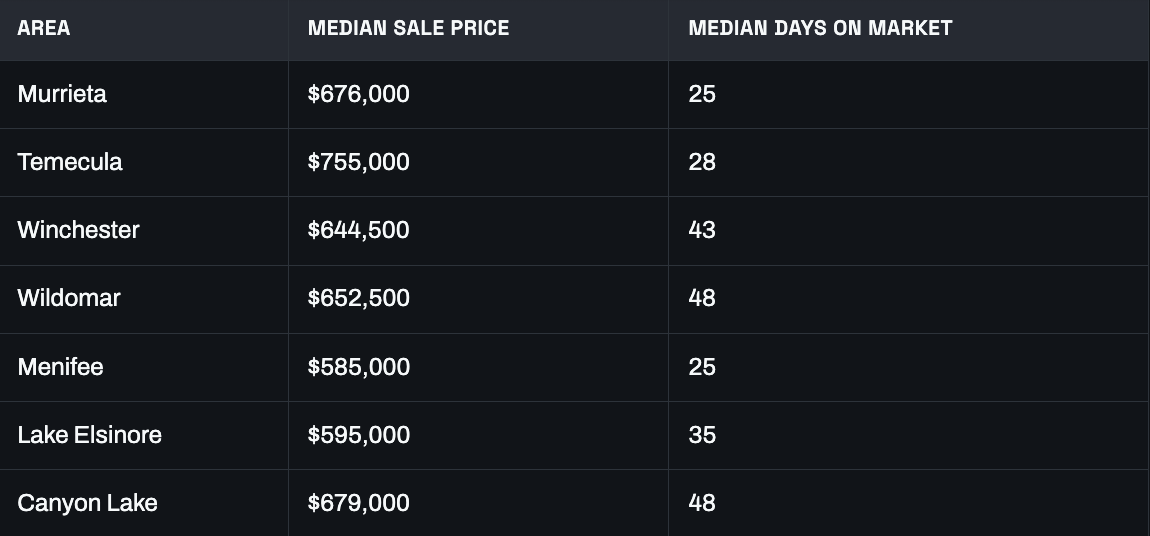
Source: Recent local market data, aggregated public listing data, trailing approximately 90 days as of September 2026. Area-level medians, individual property values vary by condition, street, and timing.
Step 2: Engage a qualified intermediary before closing
This step cannot happen after the fact. Under constructive-receipt rules, you cannot receive the sale proceeds yourself, even briefly, without disqualifying the exchange. A qualified intermediary (QI) must be in place before your relinquished property closes. The QI holds the funds, and the exchange documents need to be executed before the closing agent disburses proceeds. In Riverside County, this means coordinating between your listing agent, the closing agent, and the QI so the exchange instructions are woven into escrow before close of escrow.
A common question: can your escrow company serve as the QI? Generally, no. The IRS prohibits certain related parties, including your agent, attorney, accountant, or anyone who has acted as your agent in the past two years, from serving as QI. Your closing agent handles the mechanics of the Temecula closing, but the QI is a separate, independent party whose sole role is to hold and transfer the exchange funds.
Step 3: Close the relinquished property and start the clocks
Once your Temecula property closes, the 45-day and 180-day windows open simultaneously. The QI receives the proceeds, and you begin identifying replacement properties. If you're weighing the timing of when to pull the trigger on your sale, Sell Your Temecula Home in a Down Market or Wait? walks through the current market dynamics.
Step 4: Identify and acquire the replacement property
Submit your written identification to the QI within 45 days. Then work to close the replacement property within the 180-day window, aligning inspection timelines, loan underwriting, and escrow with that hard deadline. Local lenders who have handled 1031 transactions understand the QI's role and the timing constraints, working with one who knows this structure avoids last-minute confusion at the replacement property's closing.
For investors using exchange proceeds to fund improvements on a replacement property, a recent IRS ruling confirmed that using relinquished proceeds to build improvements can still qualify as a 1031 exchange when an exchange accommodation titleholder (EAT) and QI structure are properly in place. This is relevant for Temecula investors moving into value-add multifamily or ground-up projects, but it requires precise structuring, so bring your tax advisor and QI in early.
Step 5: Post-exchange reporting
After the exchange closes, you and your tax preparer file Form 8824 with your federal return for the year the exchange occurred. The IRS instructions for Form 8824 also note a 15% limitation on incidental personal property transferred with real property in an exchange, the aggregate fair market value of any personal property included cannot exceed 15% of the fair market value of the replacement real property received.
For California, the California Franchise Tax Board generally conforms to federal 1031 rules as of January 1, 2025, and limits like-kind exchange treatment to real property for taxable years beginning on or after that date. If you exchange a Temecula property for one located outside California, you must file Form FTB 3840 in the year of the exchange AND in each subsequent year until the deferred California-source gain is recognized. This is a recurring annual obligation, not a one-time filing, and it catches Temecula investors off guard when they trade into Nevada, Arizona, or Texas markets.
What types of Temecula properties work well in a 1031 exchange?
The like-kind standard is broad, all U.S. real estate held for investment is like-kind to all other domestic real estate, so the strategic question is less about what qualifies and more about what makes sense for your portfolio.
Common patterns I see among Temecula Valley investors:
Single-family rentals in master-planned communities exchanged into duplexes or four-plexes in Temecula or Murrieta, increasing unit count and rental income without triggering immediate tax.
Older multifamily near commercial corridors exchanged into newer, more energy-efficient multifamily or mixed-use assets, often with better management economics.
Temecula Valley equity moving into coastal or out-of-state markets (San Diego, Orange County, or out-of-state) for investors rebalancing toward different yield profiles. This works federally, but triggers the FTB 3840 annual filing requirement for any deferred California-source gain.
Multiple smaller properties consolidated into one larger asset, a common move for investors who want to simplify management while preserving equity.
Every situation is different, and the only way to know whether a specific exchange structure makes sense is to run the numbers with a tax advisor and get a current read on what the replacement market actually looks like. That's exactly the kind of conversation I have with clients before we ever put a property on the market.
Frequently Asked Questions
How does a 1031 exchange work if I'm selling a Temecula rental and buying in another state?
The federal exchange works the same way regardless of where the replacement property is located, all U.S. real estate is like-kind to all other domestic real estate under IRC §1031. The California-specific difference is that you must file Form FTB 3840 with the California Franchise Tax Board for the year of the exchange and every subsequent year until the deferred California-source gain is recognized, even though you now own property in another state. This is an annual compliance obligation, not a one-time form, and it catches many investors off guard.
What are the 45-day and 180-day deadlines, and how do they play out with Riverside County closings?
Both clocks start the day your relinquished Temecula property closes. You have 45 days to submit written identification of your replacement property to your qualified intermediary, and 180 days to close on it, or by your federal tax return due date (with extensions) for that year, whichever is earlier. In Riverside County, the practical implication is that your exchange documents must be in place with the closing agent before close of escrow on the sale side, and your replacement property's escrow needs to align its timeline with the 180-day window. Missing either deadline disqualifies the entire exchange.
Do I need a qualified intermediary for my Temecula four-plex, or can my escrow company handle it?
You need a separate qualified intermediary, your escrow company cannot serve in that role. IRS constructive-receipt rules prohibit anyone who has acted as your agent (including your real estate agent, attorney, or accountant) from serving as QI, and your closing agent is already a party to the transaction. The QI must be engaged before your relinquished property closes, there is no way to add one retroactively after proceeds are disbursed.
What happens if I take some cash out at closing in a 1031 exchange?
Any cash or non-like-kind property you receive as part of the exchange is called "boot," and the IRS taxes it as recognized gain in the year of the exchange. The remainder of the transaction can still qualify as a 1031 exchange, so you don't lose the deferral on the full amount, but you will owe taxes on the boot portion. If pulling equity out is part of your plan, work through the tax impact with your advisor before structuring the deal.
Can I 1031 out of a Temecula short-term rental into a long-term apartment building?
Potentially yes, but the short-term rental needs to qualify as investment or business-use property, not personal use, at the time of the exchange. If you have been renting it consistently as a business and not using it personally, it may qualify. The replacement property (a long-term apartment building) clearly qualifies as investment real estate held for productive use. The gray areas around personal use and intent are exactly where you need a tax advisor's guidance before you list, not after.
Getting clarity on your exchange structure before you put the property on the market is what makes the whole process manageable. The last thing you want is to close your Temecula sale and then discover a structural problem that disqualifies the exchange. If you're considering a 1031 exchange in Temecula Valley, let's talk through your current property, your target acquisition, and the timeline before the clock starts.
Schedule a consultation with Andrew Lewis at Performance Real Estate.
About Andrew Lewis
Andrew Lewis is a top-producing REALTOR® and founder of Performance Real Estate, serving the Temecula Valley and greater Riverside County. Licensed since 2012, he has closed over 500 transactions totaling more than $200 million in sales, specializing in luxury homes, listings, new construction, relocation, and investor-focused real estate.
Real Broker · (951) 237-0292
Equal Housing Opportunity. Andrew Lewis, CA DRE, Performance Real Estate DRE 01914085 / 02022092, Real Broker, licensed by the California Department of Real Estate. This article is general information only and is not legal, tax, or financial advice. Confirm your own numbers and exchange eligibility with your closing agent, tax advisor, or qualified intermediary before proceeding.