Canyon Lake offers investors a rare combination of gated lakefront lifestyle, a median sale price near $679,500, measurable rental demand with a reported median rent of $3,650/month, and a significant seasonal housing stock, all within the growing Temecula Valley market.

Is Canyon Lake a good real estate investment in 2026?
Canyon Lake is a strong candidate for Temecula Valley investors in 2026. The gated, master-planned waterfront community carries a median sale price of roughly $679,500 (recent Zillow market data), a reported median rent near $3,650/month (Realtor.com, late 2025), and a housing mix that includes a large share of seasonal and recreational units, all of which create real opportunities for both long-term landlords and lifestyle-driven buyers looking to hold a high-amenity asset.
What Makes Canyon Lake Different from Other Temecula Valley Markets
Most investors I talk to in Riverside County are comparing Canyon Lake against Murrieta, Temecula, or Lake Elsinore. Here's the honest picture: Canyon Lake isn't trying to compete with those markets on price velocity or transaction volume. It competes on something else entirely, exclusivity, lake access, and lifestyle demand that doesn't disappear when the broader market softens.
Canyon Lake is a private, gated, master-planned city. Residents get controlled entry, a private lake, beaches, a golf course, and an active HOA. You can't replicate that amenity stack anywhere else in the region. That scarcity is exactly what drives rental demand and supports long-term values even when inventory climbs.
Here's how Canyon Lake stacks up against the other markets I cover, based on recent Zillow sales data (trailing approximately 90 days, as of August 2026):
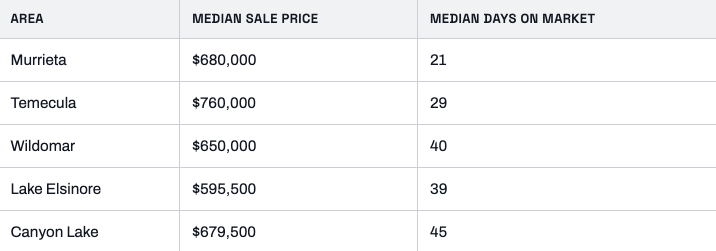
Canyon Lake's 45-day median is the longest in the group. For a traditional homebuyer, that might read as a slow market. For an investor, it means less frenzied competition and more room to negotiate. You're not going to get outbid by 15 cash offers here the way you might in a hot Murrieta subdivision.
The broader regional context matters too. Redfin's Temecula housing market data for the three months ending June 2026 shows a median sale price around $736,000, down roughly 0.5% year-over-year. Zillow's Temecula market page reports homes going to pending in about 28 days with an average value near $757,000-$760,000 and a 1-year change of approximately -0.7%. The broader Temecula Valley is experiencing slight price moderation, and Canyon Lake is moving in a similar direction, which is actually an entry-point signal for patient investors.
Current Canyon Lake Inventory and Pricing
As of August 2026, recent Zillow market data shows 94 active listings and 23 new listings in the past 30 days, with 68 homes sold over the trailing 90 days. That's a measured pace, not a distressed market, but not a feeding frenzy either.
Redfin's Canyon Lake housing market page reported a median sale price of approximately $685,000 over the three months ending May 2026, down about 2.2% year-over-year, with homes averaging 53-54 days on market and the market described as "somewhat competitive." Zillow's Canyon Lake market page puts the average home value around $704,772 with minimal year-over-year change and homes going pending in roughly 35 days.
The spread between those aggregator figures and the trailing 90-day median I cited above is normal, different data windows, different methodologies. What they agree on: Canyon Lake is holding value in the mid-to-high $600s to low $700s, and homes are moving, just not instantly. For an investor who wants to underwrite a deal carefully rather than race to close, that's a workable environment. If you want to see exactly what $700K gets you in this market, I broke that down in a separate post that's worth reading before you start touring.
The Rental Demand Case for Canyon Lake
This is where Canyon Lake's investment story gets interesting. A late-2025 Realtor.com Canyon Lake market report listed approximately 14 rental properties with a median rent of $3,650/month and year-over-year rent growth in the range of 9-20% depending on the metric. That's a thin rental inventory against meaningful demand, which is exactly the supply-demand dynamic a landlord wants to see.
The official data tells an even more specific story. The City of Canyon Lake's 6th-cycle Housing Element, adopted February 2022, cites California Department of Finance estimates showing 606 of 4,589 housing units are vacant, a 13.2% vacancy rate. But here's the breakdown that matters for investors: of those 606 vacant units, roughly 416 are classified as seasonal, recreational, or occasional use. Only about 100 are vacant rental units.
What that tells me is that Canyon Lake has a dual-market dynamic. There's a core long-term rental base, and there's a large seasonal/lifestyle segment that drives demand spikes. Both can work for investors, but they require different strategies, and different conversations with the HOA about what's permitted. I'll say this directly: before you underwrite any short-term or vacation rental play in Canyon Lake, you need to review the current HOA documents and any applicable city ordinances. The community's private governance structure means rental rules can differ meaningfully from what you'd encounter in a standard Riverside County neighborhood. That's not a reason to avoid it, it's just a due-diligence step I walk every investor client through before we go any further.
Timing Your Entry
A 2026 Canyon Lake market overview from Houzeo notes that August through December tends to be the strongest window for buyers, with supply elevated and demand lower during that stretch. That analysis is based on portal data rather than official statistics, so treat it as directional context rather than a hard rule, but it does align with the seasonal housing dynamic the Housing Element documents. If a large share of Canyon Lake's vacant units are seasonal, it stands to reason that fall and early winter bring more motivated sellers and less buyer competition.
We're in that window right now. Inventory is up. Days on market are longer than in nearby cities. Sellers who've been listed through the summer are increasingly open to negotiation. For investors who've done their homework, August through the end of the year has historically been the time to move in Canyon Lake.
According to NAR's research and statistics, investor activity in lifestyle and waterfront markets tends to track closely with broader interest rate movements and regional employment trends, both of which are worth monitoring as you time your entry. The CFPB's mortgage resource center is a good starting point if you're evaluating financing options for an investment purchase.
For a side-by-side look at how Canyon Lake compares to a neighboring community on lifestyle and investment factors, my Canyon Lake vs. Wildomar comparison covers the tradeoffs in detail.
What Investors Should Know Before They Buy
Canyon Lake's gated, amenity-rich structure is its biggest draw, and its biggest due-diligence requirement. Here's what I cover with every investor client before we start making offers:
HOA rules on rentals. Canyon Lake's HOA governs a wide range of property use. Rental policies, minimum lease terms, short-term rental restrictions, and guest access rules all need to be verified directly with the HOA before you commit to a strategy. Don't rely on what a listing agent tells you, get it in writing from the association.
Property type and lake access. Not every Canyon Lake home has direct lake frontage or a private dock. The distinction between lake-view, lake-access, and lakefront properties affects both rental pricing and resale value. Understand what you're buying.
HOA fees and assessments. The amenity infrastructure that makes Canyon Lake attractive to renters and buyers also comes with ongoing HOA costs. Factor those into your cash-flow analysis. Your lender and escrow officer can help you model the full picture.
Mello-Roos and special assessments. Parts of Riverside County carry Mello-Roos community facility district taxes. Verify whether the specific parcel you're targeting has any special tax obligations, your escrow officer will pull this during the title process.
Exit strategy and resale liquidity. With 45 median days on market and roughly 68 sales in the trailing 90 days, Canyon Lake is a smaller, more specialized market than Murrieta or Temecula. That's fine for a hold strategy, but worth factoring in if you might need to sell quickly.
The California Association of REALTORS® publishes disclosure and due-diligence guidance that's useful for investors navigating HOA-governed communities. The California Department of Real Estate also maintains resources on common interest developments and HOA disclosures that apply directly to a purchase like this.
For investors who want a fuller picture of what daily life in the community looks like, which matters when you're evaluating tenant demand and rental positioning, my Complete Guide to Living in Canyon Lake covers the community in depth.
Every Canyon Lake investment situation is different. The right strategy depends on your financing, your hold period, your tolerance for HOA governance, and what the specific property's rental history or income potential actually looks like. That's the conversation I have with investors before we ever look at a single listing.
Frequently Asked Questions
Is Canyon Lake a good place to buy a rental property right now?
Canyon Lake shows meaningful rental demand signals heading into late 2026. A late-2025 Realtor.com report documented a median rent of $3,650/month with year-over-year rent growth in the range of 9-20%, and the city's official Housing Element identifies roughly 100 vacant rental units against a broader pool of lifestyle and seasonal housing. The market is slower-moving than Murrieta or Temecula, which gives investors more negotiating room, but you need to verify HOA rental rules for any specific property before committing to a strategy.
How does Canyon Lake compare to Temecula for investors in 2026?
Temecula's median sale price runs higher (around $760,000 per recent Zillow data) and homes move faster (29 median days on market vs. 45 in Canyon Lake). Canyon Lake trades some of that price appreciation speed for a waterfront lifestyle premium, thinner rental inventory, and a seasonal demand dynamic that can support strong rents. Investors who want a lifestyle-differentiated asset with room to negotiate will find Canyon Lake more interesting; those prioritizing rapid resale liquidity may prefer Temecula or Murrieta.
What does Canyon Lake's vacancy rate mean for investors?
The City of Canyon Lake's adopted Housing Element cites a 13.2% vacancy rate, but the breakdown matters. Of approximately 606 vacant units, roughly 416 are classified as seasonal, recreational, or occasional use, not empty or distressed. That reflects Canyon Lake's identity as a lifestyle and second-home destination. For investors, it signals seasonal demand peaks and a potential short-term rental niche, subject to HOA and city rules that must be verified before purchase.
What months are best for investors to buy in Canyon Lake?
A 2026 Houzeo market analysis notes that August through December typically brings higher supply and lower buyer demand in Canyon Lake, a pattern consistent with the community's large seasonal housing stock. That window aligns with where we are right now in August 2026, with 94 active listings and 45-day median days on market. Investors who've done their due diligence are in a reasonable position to negotiate during this stretch.
Are there restrictions on renting out a Canyon Lake home?
Canyon Lake is governed by a private HOA with rules that can affect rental policies, minimum lease terms, and short-term rental activity. Specific rules vary and are not fully detailed in publicly available market data, you need to request and review the current CC&Rs and any HOA rental policy documents directly before making an offer. Your real estate agent and escrow officer can help you obtain these during the due-diligence period.
Canyon Lake's combination of gated waterfront amenities, measured inventory, and documented rental demand makes it one of the more distinctive investment opportunities in the Temecula Valley. The deals aren't handed to you, you need to know the community, understand the HOA structure, and run the numbers carefully. That's exactly the kind of groundwork I do with every investor client I work with here.
If you're evaluating Canyon Lake as an investment, schedule a consultation with my team and I'll walk you through current listings, rental comps, and the due-diligence steps specific to this market.
About Andrew Lewis
Andrew Lewis is a top-producing REALTOR® and founder of Performance Real Estate serving the Temecula Valley and greater Riverside County. Licensed since 2012, he has closed over 500 transactions totaling more than $200 million in sales, specializing in luxury homes, listings, new construction, relocation, and investor-focused real estate.
Real Broker · (951) 237-0292
Performance Real Estate DRE 01914085 / 02022092 | Real Broker | Andrew Lewis CA DRE License | Regulated by the California Department of Real Estate. This article is general information only and does not constitute legal, tax, or financial advice, confirm your specific numbers and situation with your attorney, tax advisor, lender, or escrow officer. Equal Housing Opportunity.