Riverside County real estate offers investors a mid-priced, appreciating market with strong rental demand, particularly in Temecula Valley. The county median hit $649,000 in July 2026, rents are growing modestly, and constrained inventory continues to support long-term buy-and-hold strategies over speculative flips.
Is Riverside County real estate a good investment in 2026?
Riverside County real estate is a credible investment market in 2026, anchored by a county-wide median sale price of $649,000 (July 2026), modest year-over-year price growth of about 3%, and rental demand that is holding firm as homeownership becomes less affordable for a large share of local households. Temecula Valley, the higher-priced submarket within the county, offers a mix of single-family rentals, value-add opportunities, and, for the right property, short-term rental potential tied to wine country tourism. The market is not a speculative boom, but the fundamentals for buy-and-hold investors are sound.
Key Takeaways
The Riverside County median sale price for an existing single-family home reached $649,000 in July 2026, up 3% year-over-year, according to MyNewsLA.com reporting on C.A.R. data.
Buying that median-priced home requires a household income of roughly $170,000, per C.A.R. affordability calculations, a gap that keeps rental demand strong.
Temecula's median sale price hit $757,000 in recent local market data, with homes spending a median of 26 days on market, making it the highest-priced area in the Temecula Valley submarket.
Temecula median rent was approximately $2,260–$2,280 as of August 2026, up roughly 1.1% month-over-month, per Apartment List's August 2026 rent report.
The county's Unsold Inventory Index rose to 3.8 months in July 2026, still below the 4.2-month level of a year earlier, signaling a gradually loosening but still supply-constrained market.
What does the Riverside County market look like for investors right now?
The broad picture: prices are rising slowly, transaction volume has softened, and inventory is creeping up, but not fast enough to flip the market in buyers' favor. C.A.R. data reported by MyNewsLA.com shows closed sales in Riverside County fell 13.7% from June to July 2026 and were down 2.6% year-over-year, even as the median price climbed. That combination, fewer transactions, higher prices, tells me buyers have some breathing room to negotiate, but sellers aren't under pressure to discount.
For investors, the more important number is the income required to buy. Patch's coverage of C.A.R. affordability data puts the qualifying income for a median-priced Riverside County home at roughly $170,000 a year. A large share of local households can't clear that bar, which means they rent, and that's the structural foundation that makes this market interesting for buy-and-hold investors.
Here's the area-level breakdown across Temecula Valley, using recent aggregated market data:
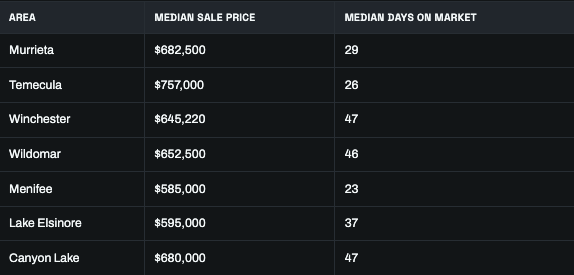
A few things jump out. Menifee has the lowest median price and the fastest pace, properties there are moving in 23 days. Winchester and Canyon Lake both sit at 47 days on market, which gives investors more time and negotiating room. Temecula commands the highest price point, and its 26-day median pace reflects continued demand. These are area-level medians; any individual property's value depends on condition, street, build year, and timing.
On the rate side, a 30-year fixed mortgage near 6.65% (mid-August 2026, per market tracking) means leveraged returns are tighter than they were a few years ago. That's not a reason to sit out, it's a reason to underwrite carefully, consider larger down payments or rate buydowns, and focus on properties where the rent-to-price math actually works.
How does Temecula Valley fit within the broader Riverside County picture?
Temecula Valley functions as a higher-priced, lifestyle-driven submarket within Riverside County. The wine country, events calendar, and commuter access to San Diego and Orange County give it a different demand profile than, say, the eastern desert communities. That cuts both ways for investors: the tenant base tends to be stable, but acquisition prices are higher and cash-flow math is tighter.
The Southwest Riverside County Association of REALTORS® (SRCAR) noted in a February 2026 market update that inventory was continuing to build and that attached product, townhomes, was listing around $799,999 in parts of the region. That's not a cheap entry point, and it raises a real question for investors about whether a townhome in a master-planned community actually pencils out once HOA dues are factored in. I'll come back to that.
Which investment strategies make the most sense in Temecula Valley?
Buy-and-hold single-family rentals
This is the most straightforward strategy in this market, and the one I see working most consistently for my investor clients. The tenant base for well-located single-family homes in Murrieta, Temecula, and Menifee tends to be stable, households commuting to job centers in San Diego, Orange County, and the Inland Empire who need more space than an apartment provides but can't qualify for a mortgage at today's prices.
Temecula's median rent was approximately $2,260–$2,280 as of August 2026, with modest growth of about 1.1% month-over-month and 0.8% year-over-year, per Apartment List's August 2026 rent report. That's not explosive rent growth, but it's positive and consistent, exactly what a buy-and-hold investor needs to model a realistic hold period. Your actual rent on a specific property will depend on size, condition, and location within the submarket, so run the numbers with a local property manager before you commit.
Value-add and BRRRR opportunities
The 99.2% sale-to-list-price ratio in Temecula for May 2026 MLS data tells you that well-presented, well-priced homes are selling close to ask. But the areas with longer days on market, Winchester and Canyon Lake at 47 days, Lake Elsinore at 37, suggest there's a segment of properties sitting longer, often because of cosmetic issues, layout problems, or motivated sellers.
That's where value-add strategies live. Cosmetic rehabs, energy-efficiency upgrades, and minor layout improvements can meaningfully improve rentability and long-term value without requiring a full gut renovation. The key is finding the stale listing with a real reason it's been sitting, not a structural problem, but something a motivated investor can fix. I walk my clients through exactly this kind of analysis before they make an offer, because the difference between a value-add opportunity and a money pit is often visible in the first walkthrough if you know what to look for.
For a closer look at what your acquisition dollar buys in one of the valley's more affordable cities, see what $500K–$1M buys in Wildomar.
Short-term and vacation rentals
Temecula's wine country, event venues, and tourism draw make short-term rentals a natural conversation for investors. The demand is real. But the regulatory environment is not investor-friendly by default, and it varies by city and even by neighborhood.
Short-term rental rules in Temecula and across Riverside County are set at the municipal and county level, permit caps, occupancy limits, transient occupancy tax obligations, and neighborhood restrictions all apply. These rules change. Before you buy with a short-term rental strategy in mind, check current requirements directly with the City of Temecula and the Riverside County Transportation and Land Management Agency, not a blog or portal. A property that cash-flows as a vacation rental under today's rules may not under next year's.
For investors interested in the waterfront angle within Riverside County, the Canyon Lake waterfront investment guide covers that submarket in detail.
New construction and fringe-market acquisitions
Riverside County authorized 588 housing units by building permit in July 2026, indicating an ongoing but measured new-construction pipeline. Newer subdivisions in Menifee, Wildomar, and Winchester offer investors lower deferred-maintenance risk in the early years of a hold, a real consideration when you're managing a portfolio remotely or across multiple properties. The trade-off is that new construction typically prices at or above resale in the same area, so the appreciation upside is more limited at entry.
What about townhomes and condos?
Attached product in Temecula Valley is not the bargain-entry-point it might be in other markets. SRCAR's February 2026 data showed townhomes listing near $799,999 in parts of the region, competitive with smaller single-family homes. Add HOA dues, which vary widely by community and can run several hundred dollars a month in master-planned developments, and the cash-flow math gets tight fast. For investors, I'd weigh the HOA cost against the reduced maintenance burden honestly before assuming a townhome pencils out better than a single-family home at a similar price point.
What risks should Riverside County investors watch for?
HOA and CC&R restrictions
Many Temecula Valley communities, especially newer or master-planned ones, have HOAs with rules that directly affect investors: rental restrictions, caps on the percentage of units that can be rented, parking limitations, ADU restrictions, and exterior modification rules. These are private contractual obligations, not statutes, and they vary by community. Review the CC&Rs and contact the HOA directly before you close. An HOA that prohibits short-term rentals or limits long-term rentals to a percentage of units can completely change your investment thesis.
Wildfire, water, and insurance costs
Inland Southern California carries real exposure to wildfire risk and drought. Both affect insurance costs, which have risen significantly for properties in higher-hazard zones, and long-term desirability. Before you buy, review CalFire's fire hazard severity zone maps and check with your insurance broker on current coverage availability and cost for the specific property. This is not a reason to avoid the market, but it's a line item that has to be in your underwriting.
Short-term rental regulatory risk
If your investment thesis depends on vacation rental income, understand that local ordinances can change. Permit caps and neighborhood restrictions have tightened in many California cities over the past few years. Build a scenario where the property works as a long-term rental before you commit to a short-term strategy, that way a regulatory change doesn't force a sale at the wrong time.
Cash-flow math at current prices and rates
With a county median near $649,000, Temecula at $757,000, and a 30-year rate near 6.65%, cash-flow-positive acquisitions are not easy to find without a meaningful down payment or a property that rents above the area median. That's not unusual for Southern California, but it means investors need to underwrite honestly rather than assuming appreciation will bail out a negative-cash-flow deal. Every situation is different, the only way to know whether a specific property works is to run the actual numbers with someone who knows this market and can pull the real rental comps.
Frequently Asked Questions
Is Riverside County real estate a good investment in 2026 compared to other Southern California markets?
Riverside County offers a more accessible price point than Los Angeles or Orange County while still benefiting from the same regional job and population drivers. The county median of $649,000 (July 2026) is well below coastal Southern California medians, and the rental demand is real, C.A.R. data shows the income needed to buy at that price is roughly $170,000, which prices out a large share of local households and keeps them renting. The trade-off is tighter cash flow at current rates and a market that rewards patient, disciplined investors over speculators.
What kind of rental returns can I realistically expect on a single-family home in Temecula Valley?
Temecula's median rent was approximately $2,260–$2,280 as of August 2026, per Apartment List's rent report, with modest year-over-year growth of about 0.8%. Actual rent on a specific property depends on size, condition, location within the submarket, and whether it's furnished. At current acquisition prices, cash-flow-positive deals typically require a larger down payment or a property that commands above-median rent, a local property manager can give you realistic rent comps before you make an offer.
Is it better to invest in short-term vacation rentals or long-term leases in Temecula?
Short-term rentals can generate higher gross income in Temecula's wine country market, but they carry meaningful regulatory risk, city permit caps, occupancy limits, and transient occupancy tax obligations apply and are subject to change. Long-term rentals offer more predictable cash flow and fewer compliance variables. The right answer depends on the specific property, its location relative to wine country, and your tolerance for operational complexity, and you should verify current short-term rental rules directly with the City of Temecula before buying with that strategy in mind.
Are there still value-add opportunities in Riverside County, or is it mainly a buy-and-hold market?
Value-add deals exist, but they require patience. Areas with longer days on market, Winchester and Canyon Lake at 47 days, Lake Elsinore at 37 days, tend to have more motivated sellers and more room to negotiate on properties with cosmetic or deferred-maintenance issues. The 99.2% sale-to-list ratio on Temecula's May 2026 MLS data shows that well-priced, turnkey properties rarely discount, so investors chasing value-add need to target the listings that have been sitting, not the ones that just hit the market.
What local risks should real estate investors watch for in Riverside County?
The four I flag with every investor client: HOA restrictions that limit rentals or ADUs (common in master-planned communities), wildfire and insurance exposure in higher-hazard zones, short-term rental regulatory changes at the city and county level, and cash-flow math that doesn't work at current prices and rates without a meaningful down payment. None of these are dealbreakers, but all of them need to be in your underwriting before you commit.
Riverside County's investment case in 2026 comes down to this: prices are rising modestly, rental demand is structurally supported by an affordability gap that isn't closing quickly, and the market rewards investors who buy right and hold patiently over those looking for a quick flip. If you want to know whether a specific property in Temecula, Murrieta, Menifee, or anywhere else in the valley actually pencils out, let's talk through the numbers together, I work with investors across this market every week and can give you a real-world read on what's available and what's worth pursuing.
About Andrew Lewis
Andrew Lewis is a top-producing REALTOR® and founder of Performance Real Estate serving the Temecula Valley and greater Riverside County. Licensed since 2012, he has closed over 500 transactions totaling more than $200 million in sales, specializing in luxury homes, listings, new construction, relocation, and investor-focused real estate.
Real Broker · (951) 237-0292
Equal Housing Opportunity. Andrew Lewis, CA DRE, Performance Real Estate DRE 01914085 / 02022092, Real Broker. This article is general information only and does not constitute legal, tax, or financial advice. Confirm your own numbers with your closing agent, tax advisor, or lender. Broker fees and commissions are fully negotiable and not set by law.