Temecula Valley draws relocating households with its wine-country setting, newer single-family homes, high median incomes, and lower housing costs than coastal Southern California metros. Recent local data shows a median sale price of $790,000 in Temecula and options from $590,000 in Menifee, with homes typically selling in under 30 days.

Why do people relocate to Temecula Valley?
Temecula Valley attracts relocating households because it offers a suburban-rural lifestyle anchored by wine country, outdoor recreation, and newer single-family homes at prices that, while well above the national average, are generally lower than San Diego or Orange County. The area's high household incomes, steady population growth, and thriving tourism economy give it a stability that's hard to find in many Southern California communities its size.
Key Takeaways
Recent local market data puts the median sale price in Temecula at $790,000, with homes spending a median of 27 days on market as of September 2026.
Nearby communities offer more entry-level options: Menifee's median sale price is $590,000 and Lake Elsinore's is $592,500, both with relatively fast absorption.
Temecula's 2025 estimated median household income is $115,071, and average household income reaches $145,129, according to the City of Temecula's most recent demographics report.
Temecula Valley welcomed a record 3.4 million visitors in 2024, generating $1.137 billion in spending and supporting roughly 9,570 local jobs, per Visit Temecula Valley's most recent tourism impact report.
The California Department of Finance's 2025 E-1 estimates put Temecula's population at 112,220, reflecting steady, moderate growth that supports services without overwhelming infrastructure.
What does everyday life actually look like in Temecula Valley?
This is the question I push every relocating client to answer before they fall in love with a house. A home is easy to evaluate. The daily rhythm of a place takes more work.
Temecula Valley sits at the intersection of two identities: a working suburban community with strong commuter ties to San Diego, Riverside, and Orange County, and a genuine wine-country destination that drew a record 3.4 million visitors in 2024, according to Visit Temecula Valley. That dual identity shapes everything from weekend traffic patterns to the variety of restaurants and events available to residents year-round.
The tourism economy isn't just a backdrop. That same 2024 report credits $1.137 billion in visitor spending with supporting approximately 9,570 jobs and generating over $52 million in local tax revenue. For residents, that translates to a well-funded local services base and a hospitality infrastructure, wineries, restaurants, event venues, and outdoor recreation, that most inland communities simply don't have.
The tradeoff is real, too. Wine-country corridors get busy on weekends. Old Town Temecula draws crowds for festivals and events. If you're relocating from a quieter rural area, the activity level may surprise you. If you're coming from a coastal metro, it will feel refreshingly manageable.
The suburban-rural mix that keeps drawing people in
Temecula Valley isn't urban, and it isn't purely rural. It's a suburban-rural blend with newer master-planned communities, rolling hills, and open space that gives households more square footage and lot size than most of coastal Southern California at a comparable or lower price point.
The U.S. Census Bureau QuickFacts put Temecula's population at 112,431 as of July 2024. The California Department of Finance's 2025 E-1 estimates put it at 112,220 in 2025, with modest annual growth around 1.2%. The city's own 2025 Pop-Facts Demographics report projects growth continuing to roughly 114,000 by 2030. That's steady, not explosive, which matters for infrastructure and quality of life.
The communities surrounding Temecula add range. Murrieta sits just north and tends to attract households looking for slightly more affordable options with strong commuter access. Winchester and Wildomar offer newer construction with more land. Menifee has grown significantly and offers some of the most accessible price points in the valley. Canyon Lake is its own gated community centered on a private lake. Each has a distinct feel, and part of my job when working with relocating clients is helping them understand those differences before they start touring homes.
If you want a deeper look at what separates these communities day to day, my post on living in Temecula CA covers the tradeoffs in detail.
What does the housing market look like for someone relocating right now?
Recent local market data puts the Temecula median sale price at $790,000, with homes spending a median of 27 days on market. There are currently 487 active listings, and 136 new listings came to market in the past 30 days, with 398 homes closed in the past 90 days. That's an active, competitive market, but not a frantic one.
For relocating households with more flexibility on community, the broader valley offers meaningful price variation. Here's how the surrounding areas compare right now, based on recent aggregated public listing data:
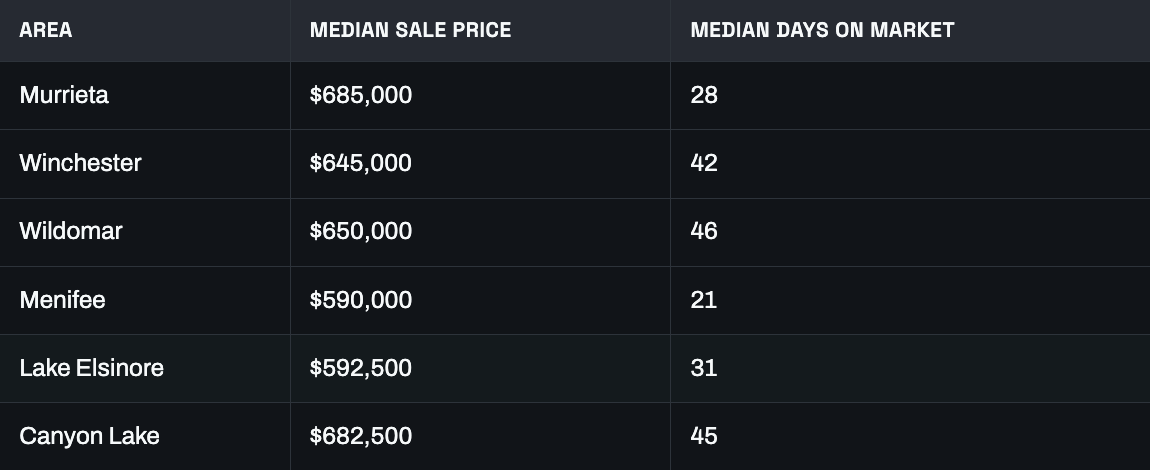
These are area-level medians. An individual home's value varies based on condition, street, build year, and timing, and the only way to know what a specific property is worth is to run a real analysis. That said, the range here is meaningful: a household that prioritizes space and newer construction over a Temecula address has real options between $590,000 and $690,000 in communities that still put them within easy reach of everything the valley offers.
For context on how Temecula compares to San Diego, where many of my relocating clients are coming from, I'd point you to my post on why San Diego families are quietly leaving for Temecula. The price-per-square-foot and lot-size difference is significant.
What about the cost of living beyond housing?
Housing is the biggest driver, but it's not the whole picture. BestPlaces assigns Temecula a cost-of-living index of 131.2, meaning overall living costs run about 31% above the U.S. average. LivingCost.org ranks Temecula 525th out of 2,202 U.S. cities by expense and 235th out of 319 California cities, putting it solidly in the expensive tier nationally but not at the extreme end within the state.
What helps offset that is income. The city's own 2025 demographics report lists a median household income of $115,071 and an average household income of $145,129. ACS 2020-2024 estimates compiled by SalaryMapUSA put median household income around $121,063. Either way, the income profile of the community is high relative to national benchmarks, which helps explain why the area sustains the housing prices it does.
Relocators coming from lower-cost states or regions need to plan for that adjustment. The lifestyle here is genuinely compelling, but the costs are real. I'd rather walk a client through an honest budget conversation up front than have them feel blindsided six months after they move in. If you want a frank breakdown of what often catches newcomers off guard, my post on the hidden costs of living in Temecula covers the details most people don't think to ask about.
According to Numbeo's 2025 cost-of-living data for Temecula, three-bedroom apartment rents typically run in the $2,500 to $3,999 range, and one-bedroom units in the city center fall in the $1,500 to $2,666 range. Rental inventory is available, but this is not a budget rental market. Most households relocating here are targeting ownership, and the single-family home stock reflects that.
Your specific situation, your income, your target price range, your must-haves in a community, determines which part of the valley makes sense for you. That's exactly the conversation I have with every relocating client before we start looking at listings.
Frequently Asked Questions
How expensive is it to live in Temecula Valley versus San Diego or Orange County?
Temecula Valley's housing costs are generally lower than San Diego or Orange County, even though the area runs about 31% above the U.S. average overall, according to BestPlaces. The tradeoff is that you typically get more square footage, newer construction, and larger lots for a comparable or lower price than coastal metros, while still being within commuting distance of both San Diego and Orange County job centers. HomeSnacks, drawing on ACS 2020-2024 data, places Temecula's median home value around $766,378, which tracks below median prices in most San Diego and coastal Orange County zip codes.
What is the lifestyle like in Temecula Valley, and is it more suburban, rural, or urban?
Temecula Valley is a suburban-rural blend with no meaningful urban core, so if walkable city living is the goal, it won't fit. What it does offer is newer master-planned communities, wine country, outdoor recreation, and a resort-like amenity base that most inland Southern California cities don't have. The median age in Temecula is approximately 36.7, reflecting a relatively young community with strong demand for parks, recreation, and commuter connectivity.
How big is Temecula Valley's wine and tourism scene, and does it affect daily life for residents?
It's significant enough to notice. Temecula Valley welcomed a record 3.4 million visitors in 2024, generating $1.137 billion in spending and supporting roughly 9,570 jobs, per Visit Temecula Valley's most recent tourism impact data. For residents, that means excellent restaurants, events, and hospitality options are close by, but wine-country corridors and Old Town Temecula get noticeably busy on weekends and during festivals.
What is the typical household income in Temecula, and does it match the cost of living?
The city's 2025 demographics report lists a median household income of $115,071 and an average of $145,129, which are well above national medians and help explain how residents absorb the area's higher housing and living costs. That said, relocators coming from lower-cost regions should plan carefully: LivingCost.org estimates an average monthly cost of about $2,690 for one person, and housing is the single largest variable in that number.
Is Temecula Valley still growing, or has the population leveled off?
Growth is steady but moderate. The California Department of Finance's 2025 E-1 estimates put Temecula at 112,220 residents in 2025, up from 110,898 in 2024, roughly 1.2% annual growth. The city's own projections point to about 114,000 by 2030. That pace is enough to sustain services and amenities without the infrastructure strain that comes with rapid boom growth.
The bottom line on relocating to Temecula Valley
Temecula Valley offers something genuinely distinct in Southern California: a wine-country lifestyle, newer housing stock, high household incomes, and a stable, growing community at prices that, while real, are lower than most coastal alternatives. The tradeoffs are real too, and I'd rather you understand both sides before you commit to a market and a home.
If relocation is on your horizon and you want an honest, experience-based picture of what daily life looks like across Murrieta, Temecula, Menifee, Winchester, and the rest of the valley, let's talk. I work with relocating households regularly and I know these communities well enough to give you the full picture, not just the highlights. Schedule a consultation with my team here.
About Andrew Lewis
Andrew Lewis is a top-producing REALTOR® and founder of Performance Real Estate serving the Temecula Valley and greater Riverside County. Licensed since 2012, he has closed over 500 transactions totaling more than $200 million in sales, specializing in luxury homes, listings, new construction, relocation, and investor-focused real estate.
Real Broker · (951) 237-0292
Equal Housing Opportunity. Andrew Lewis, CA DRE, Performance Real Estate DRE 01914085 / 02022092, Real Broker, regulated by the California Department of Real Estate. This article is general information only and is not legal, tax, or financial advice; confirm your own numbers with your closing agent, tax advisor, or lender.