Temecula Valley sellers typically encounter costs in several categories at closing: agent compensation, Riverside County documentary transfer tax, escrow fees, owner's title insurance, recording fees, HOA transfer fees, and prorated property taxes. The exact total depends on your sale price, mortgage balance, HOA status, and what you negotiate in the purchase contract.

What do Temecula Valley home sellers actually pay at closing?
Temecula Valley sellers pay costs in several distinct categories at closing: agent compensation, Riverside County documentary transfer tax, escrow fees, owner's title insurance, recording fees, HOA transfer and document fees (if applicable), and prorated property taxes and HOA dues. The specific total depends on your sale price, your mortgage payoff, your HOA situation, and what gets negotiated in your purchase contract, there is no single fixed number that applies to every transaction.
Here's what I walk every seller through before we even talk about list price: understanding where your money goes at closing so there are no surprises on settlement day.
The Temecula Market Context for 2026
Before getting into the cost categories, it helps to know where prices are sitting. Recent Zillow market data for Temecula (trailing approximately 90 days as of August 2026) shows a median sale price of $750,000, with 403 homes sold and a median of 29 days on market. That puts the $750,000–$775,000 range squarely at or just above the current city median, meaning the closing cost picture I'm describing here is grounded in what real sellers in this market are actually experiencing right now.
For context across the broader Temecula Valley, here's how recent medians compare by area:
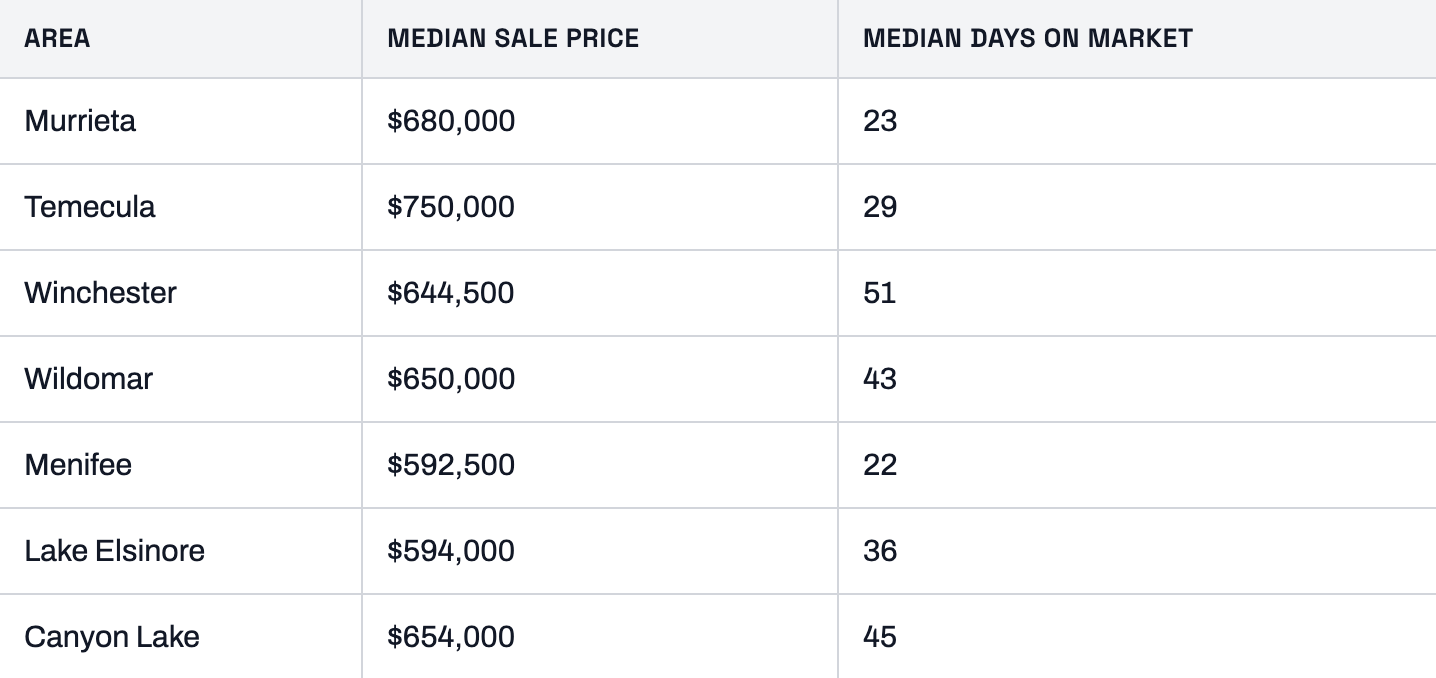
Source: Zillow sales data, trailing ~90 days, as of August 2026. Area-level medians, individual home values vary by condition, street, and timing.
These figures align closely with what Redfin's Temecula housing market data shows: a median sale price of $736,349 for the three months ending June 2026, with a ZIP-code-level snapshot for 92592 showing $750,000 as of May 2026. Those are the most recent figures available as of this writing in August 2026.
What Sellers Actually Pay: The Line Items
Agent Compensation
This is typically the largest single cost category for a seller. Broker fees and commissions are fully negotiable and not set by law, there is no standard or customary rate, and I won't quote one here because it genuinely varies by transaction, property, and what services you need. What I will tell you is that your listing fee is agreed in your listing agreement, and any compensation a seller chooses to offer a buyer's agent is a separate, optional decision, not an automatic combined total. If you want to understand what this would look like for your specific home, that's a conversation we have directly.
For a deeper look at how buyer-agent compensation works post-2024, see my post on whether Temecula sellers pay buyer's agent commission.
Riverside County Documentary Transfer Tax
This is the one seller cost in Temecula where the rate is actually set by statute. Riverside County's documentary transfer tax is $1.10 per $1,000 of the property's value or consideration (technically $0.55 per $500), consistent with the baseline California documentary transfer tax authorized under Revenue and Taxation Code §11911.
One thing worth knowing: Temecula does not have an additional city transfer tax. Only property located inside the City of Riverside itself carries an extra city layer. Temecula sellers pay county only, per the Riverside County Code of Ordinances §4.08.030.
By local custom, this tax is typically paid by the seller, though as California escrow professionals note, the county recorder doesn't dictate who pays, only that it gets paid. It's contractual, and allocation can be negotiated. Confirm how it's handled in your specific purchase contract.
Escrow Fees
California is an escrow state, and escrow is a real cost. In Riverside County, escrow fees are commonly split between buyer and seller, though the exact split is negotiable and set in the purchase contract. The fee itself is calculated based on the escrow company's rate schedule and the sale price, so a $750,000 transaction will carry a higher escrow fee than a $500,000 one. Your escrow officer will give you a fee disclosure at the start of escrow.
Owner's Title Insurance
In Riverside County, it's common practice for the seller to pay for the owner's title insurance policy. This policy protects the buyer against title defects that predate the sale. Like most closing costs, it's technically negotiable, but going in expecting to cover it is the standard local approach. Title insurance premiums in California are regulated, so the rate is based on the sale price and set by the title company's filed schedule.
Recording Fees
The grant deed transferring ownership to the buyer must be recorded with the Riverside County Clerk-Recorder. If you have a mortgage, the reconveyance of your deed of trust also gets recorded once your loan is paid off. These recording fees are relatively modest line items on your closing statement, but they're there.
HOA Transfer and Resale Document Fees
If your Temecula home is in an HOA, and many are, particularly in communities like Harveston, Redhawk, Wolf Creek, and others across the valley, expect HOA-related fees at closing. These typically include the cost of the resale disclosure package (the documents the HOA is required to provide to the buyer) and a transfer fee charged by the HOA or its management company.
By custom, the seller usually covers these costs, but the purchase contract can reallocate them. The amounts vary by HOA and management company. Before you list, I'd recommend requesting a fee schedule from your HOA so there are no surprises. California's Davis-Stirling Act governs what HOAs can charge for these documents, so the fees aren't unlimited, but they're real and worth knowing in advance.
Prorated Property Taxes and HOA Dues
California property taxes run on a fiscal-year cycle (July 1 through June 30), billed in two installments. When you sell, escrow calculates exactly how many days of the tax year you owned the property and how many days the buyer will own it. You get debited or credited accordingly on your closing statement. As AmeriSave's California closing cost guide explains, the proration is based on the day the deed records, so closing date matters.
The same logic applies to HOA dues. If you've prepaid dues for a period that extends past your closing date, you'll receive a credit. If dues are owed through closing, you'll be debited. It's a clean accounting of what each party owes for their portion of ownership.
Loan Payoff and Reconveyance
If you have a mortgage, your lender's payoff balance, including any accrued interest through the payoff date, comes out of your proceeds at closing. Your lender will also charge a reconveyance fee to release the deed of trust from title. This isn't technically a "closing cost" in the traditional sense, but it's money that comes off your net proceeds, so it belongs in any honest conversation about what sellers walk away with.
For a full picture of what you'd actually net after all of these costs, my post on what Temecula Valley sellers net at closing walks through the proceeds side of the equation.
Which Costs Are Fixed and Which Are Negotiable?
This is the question I get most often once sellers understand the categories. Here's a quick breakdown:
Fixed by statute: The Riverside County documentary transfer tax rate ($1.10 per $1,000) is set by ordinance. You don't negotiate the rate, but you can negotiate which party pays it.
Set by filed schedules: Title insurance premiums and recording fees are based on filed rates. The amounts are predictable once you know the sale price.
Negotiable in the purchase contract: Who pays escrow fees, HOA transfer fees, and the transfer tax itself can all be addressed in your offer and counteroffer. In a competitive market, buyers sometimes agree to cover costs that sellers typically pay, and vice versa in a softer market.
Fully negotiable: Agent compensation, in all its forms, is negotiated between you and your agent. No rate is standard, customary, or fixed.
Calculated at close: Property tax and HOA prorations are determined by your actual closing date, so they're only final when escrow closes.
Every situation is different, and the only way to know your actual number is to run through it with someone who knows this market and your specific property. That's exactly what a pre-listing consultation with me covers.
Frequently Asked Questions
Who pays the Riverside County transfer tax when I sell my Temecula home?
By local custom, the seller typically pays the Riverside County documentary transfer tax, which is set at $1.10 per $1,000 of the sale price under Riverside County Code of Ordinances §4.08.030. That said, it's contractual, not statutory, so it can be negotiated between buyer and seller. As California escrow professionals note, the county recorder only requires that it gets paid, not which party pays it. Confirm the allocation in your purchase contract.
What closing costs do Temecula sellers pay besides agent commissions?
Beyond agent compensation, Temecula sellers commonly pay the Riverside County documentary transfer tax, their share of escrow fees, the owner's title insurance policy, recording fees for the grant deed and loan reconveyance, HOA transfer and resale document fees (if in an HOA), and prorated property taxes and HOA dues through the closing date. Each of these is a separate line item on your closing statement, and several are negotiable in the purchase contract.
Does Temecula have a city transfer tax on top of the county tax?
No. Temecula sellers pay only the Riverside County documentary transfer tax at $1.10 per $1,000 of the sale price. The City of Riverside has an additional city-level transfer tax, but that applies only to property within the City of Riverside itself, not to Temecula, Murrieta, or other Temecula Valley cities. This is confirmed by the Riverside County Clerk-Recorder's recording requirements.
What HOA fees should I expect at closing when selling my Temecula home?
If your home is in an HOA, expect two main cost categories at closing: the resale disclosure package fee (the documents the HOA must provide to the buyer, governed by California's Davis-Stirling Act) and a transfer fee charged by the HOA or its management company. By custom, sellers typically cover these, though the purchase contract can shift responsibility to the buyer. I recommend requesting your HOA's current fee schedule before listing so you know what to expect, amounts vary by association and management company.
How do property tax prorations work when I sell my Temecula home?
California property taxes run on a fiscal year from July 1 through June 30. When your sale closes, escrow calculates how many days of the tax year you owned the property versus how many days the buyer will own it, and your closing statement reflects a debit or credit for your share through the recording date. If you've prepaid taxes that cover a period after closing, you'll receive a credit; if taxes are owed through closing, you'll be debited. The exact amount depends on your closing date and Riverside County's assessed value for your property.
Are escrow fees in Riverside County split 50/50 between buyer and seller?
Splitting escrow fees equally between buyer and seller is common practice in Riverside County, but it's not a legal requirement, it's a negotiated term in the purchase contract. The total escrow fee is based on the escrow company's rate schedule and the sale price, so both parties should review the escrow fee disclosure at the start of the transaction. In some negotiations, one party agrees to cover a larger share as part of the overall deal.
Understanding your closing cost categories before you list is the difference between a smooth closing and an unpleasant surprise at the settlement table. If you're thinking about selling in Temecula, Murrieta, or anywhere in the Temecula Valley, I'll walk you through a full pre-listing picture, what you'll pay, what you'll net, and how to position your home competitively in today's market.
Schedule a consultation with Andrew Lewis to get a personalized net-sheet and a clear game plan before you list.
About Andrew Lewis
Andrew Lewis is a top-producing REALTOR® and founder of Performance Real Estate, serving the Temecula Valley and greater Riverside County. Licensed since 2012, he has closed over 500 transactions totaling more than $200 million in sales, specializing in luxury homes, listings, new construction, relocation, and investor-focused real estate.
Real Broker · (951) 237-0292
Equal Housing Opportunity. Andrew Lewis, CA DRE, Performance Real Estate DRE 01914085 / 02022092, Real Broker. This article is general information only and does not constitute legal, tax, or financial advice. Confirm your specific costs and closing figures with your attorney, tax advisor, lender, or escrow officer. Regulated by the California Department of Real Estate.