Your net proceeds from a Temecula Valley home sale equal your sale price minus your loan payoff, real estate commission, documentary transfer tax, escrow and title fees, recording charges, any seller credits, HOA transfer fees, and prepaid costs. Every line is negotiable except fixed statutory fees, so a personalized net sheet is the only way to know your real number.

What will I actually net when I sell my house in Temecula Valley?
Your net proceeds are your sale price minus every cost and payoff that runs through escrow before the wire hits your account. In Temecula Valley that typically includes your loan payoff, real estate commission, documentary transfer tax, escrow fees, title insurance, recording charges, any seller credits or concessions, HOA transfer fees if you're in a common-interest community, and prorated property taxes. Most of those line items are negotiable. A few are set by statute. None of them should be a surprise on closing day, and that's exactly what a seller net sheet is for.
The Cost Categories That Reduce Your Proceeds
Here's what I walk every seller through before we even talk about a list price. Understanding the categories first makes the actual numbers less stressful when they land on paper.
Your Loan Payoff
This is usually the biggest deduction. Escrow will request a formal payoff demand from your lender that includes your remaining principal, interest accrued to the projected close date, and any reconveyance or release fees. If your loan has a prepayment penalty, which California law permits under specific conditions, that shows up here too. Review your original loan documents or call your servicer before you list so there are no surprises. The payoff demand is the one number on your net sheet that isn't negotiable.
Real Estate Commission
Under California Department of Real Estate rules, commissions are fully negotiable. There is no standard, customary, or legally fixed rate, none. The listing fee is agreed between you and your listing brokerage in the listing agreement. Any compensation a seller chooses to offer a buyer's agent is a separate, optional decision, it's not automatically bundled in, and it's no longer shared on the MLS under current National Association of REALTORS® practice rules. If you want to know what commission would look like for your specific situation, that's a conversation to have directly with me, not something to estimate from a blog post.
Documentary Transfer Tax
California counties collect a documentary transfer tax on every real property transfer under the Documentary Transfer Tax Act in the California Revenue and Taxation Code. Riverside County collects this tax, and the calculation is based on the consideration or value transferred, recorded with the Riverside County Assessor-County Clerk-Recorder when your grant deed is filed. Local custom in Riverside County often has the seller covering this cost, but the Riverside County Assessor-County Clerk-Recorder and the California Revenue and Taxation Code both make clear that which party actually pays is determined by what you and the buyer agree to in the purchase contract. Don't assume it's yours to pay until you've seen the offer.
Escrow Fees
California is an escrow state. A licensed escrow company acts as the neutral third party that holds funds, coordinates the loan payoff, manages document signing, and disburses your net proceeds after everything closes. Per the California Department of Real Estateescrow fees are set by each company's own rate schedule, not by state law. In Temecula Valley, it's common for escrow fees to be split between buyer and seller, but that split is set in the purchase agreement, not by any rule. Get the escrow company's fee sheet early so you know what you're looking at.
Title Insurance
In California residential sales, the seller typically provides an owner's title insurance policy to the buyer, protecting their ownership against undisclosed liens or title defects. The buyer's lender gets a separate lender's policy. Per the California Land Title Associationpremiums follow filed rate schedules that vary by insurer and county. Local custom in Riverside County has the seller paying the owner's policy, but the CLTA and California Association of REALTORS® both label this as customary practice, not a legal requirement. It can be negotiated.
Recording Fees and Other County Charges
The grant deed and any related documents get recorded electronically with Riverside County by the title or escrow company at closing. Recording fees follow the county's published fee schedule. These amounts are relatively modest but they do appear as line items on your closing statement. The Riverside County Assessor-County Clerk-Recorder publishes its current fee schedule online.
HOA Transfer Fees
If you're in one of the many HOA communities across Temecula, Murrieta, or Wildomar, and a lot of the newer subdivisions are, expect HOA transfer fees and document preparation fees to appear on your net sheet. These are governed by California's Davis-Stirling Common Interest Development Act and your individual HOA's bylaws. They're not huge numbers, but they're real, and they can catch sellers off guard. Our guide to Temecula Valley HOA communities gives you a sense of what's common in the area. Whether the buyer or seller pays these fees is negotiated in the contract.
Seller Credits and Concessions
This one is entirely within your control, until it isn't. After inspections, buyers in Temecula Valley often submit a Request for Repair or ask for a credit in lieu of repairs. Any credit you agree to runs through escrow and comes straight off your net. According to NAR guidance on seller concessions credits tend to become more common when buyer demand softens or when interest rates push buyers to ask for rate buydown help. I generally advise sellers that a credit is cleaner than doing repairs mid-escrow, it's a single line item on the net sheet instead of a pile of invoices, but the right answer depends on your specific situation and the offer in front of you.
Prorated Property Taxes and Prepaid Items
California property taxes are assessed on the purchase price under Proposition 13 rules administered by the California State Board of Equalization. As a seller, you'll owe taxes prorated through your close date. If you've prepaid taxes beyond closing, you'll get a credit. If you're behind, escrow will collect the shortfall. Mello-Roos assessments, which are common in newer Temecula Valley communities, prorate the same way and can be a meaningful number depending on your district.
What a Seller Net Sheet Actually Shows You
A seller net sheet is a non-binding estimate, every legitimate one is labeled that way, but it gives you a realistic range before you commit to a list price or accept an offer. I build these at every listing presentation. Here's what the structure looks like:
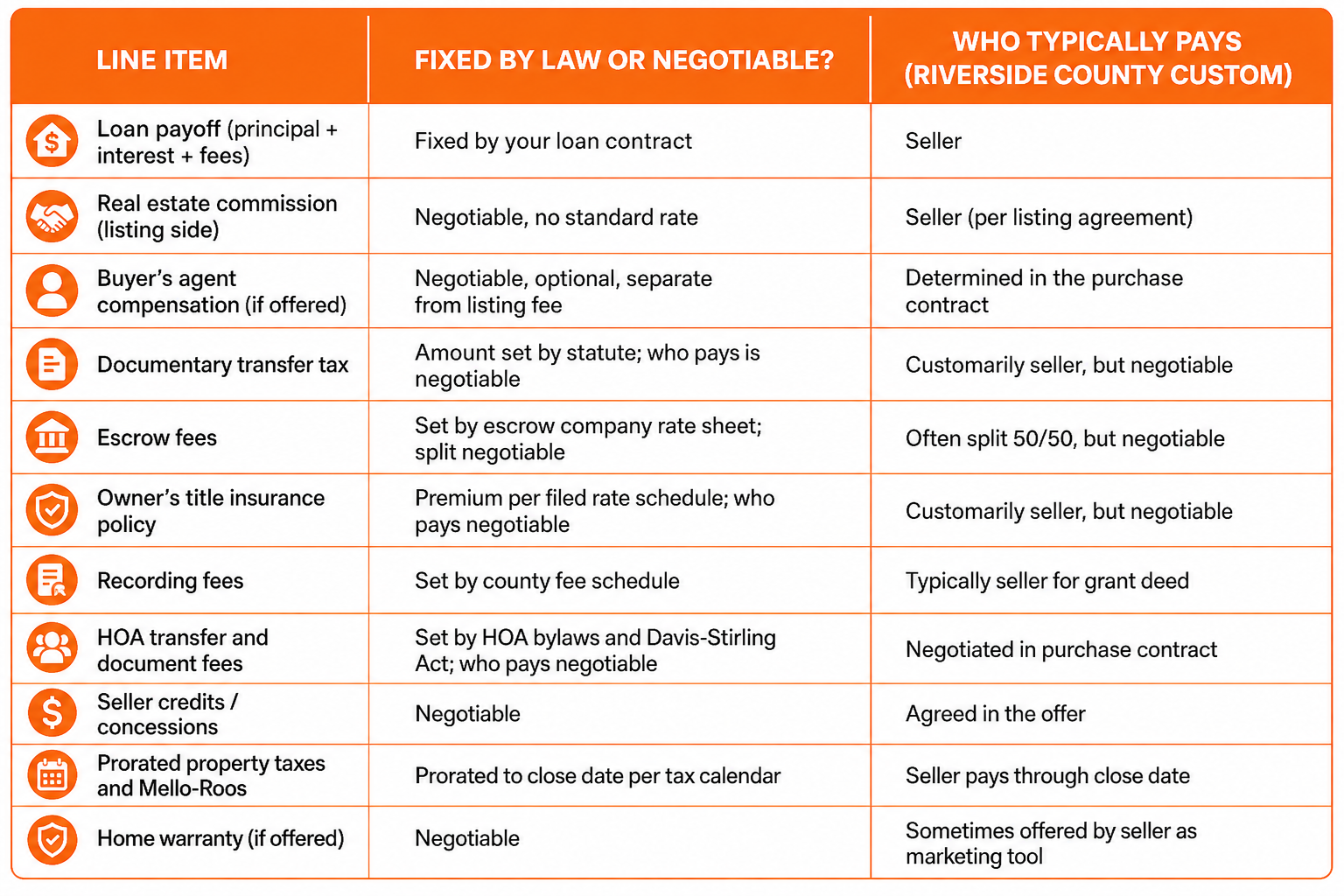
Every number in that table is an estimate until you have an actual offer with an actual close date. That's why the net sheet gets rebuilt every time a new offer comes in, the sale price, concessions, and close date all shift the math.
City-Specific Considerations in Temecula, Murrieta, and Wildomar
One thing I always flag for sellers: the city your home is in can matter. Some Riverside County cities have local point-of-sale requirements, utility inspections, safety clearances, or other items tied to city ordinance or utility district rules. The City of Temecula has its own municipal code and building and safety requirements that a local agent checks as part of listing prep. Murrieta and Wildomar have their own rules too. If a required inspection turns up an issue, the cost allocation gets negotiated in the purchase agreement, but the existence of the requirement can affect your timeline and potentially your net if you agree to cover related costs.
Timeline Affects Your Net Too
Getting clarity on both the financial projection and the realistic timeline is something I always pair together for my clients. Local brokerage guides for Temecula Valley describe a common close timeline of around 30 days from contract acceptance for financed purchases, with cash purchases often closing faster, but that's custom, not law, and it depends on financing, appraisal, inspections, and escrow processing. A longer close means more accrued interest on your loan payoff. A delayed close can also shift which property tax installment you owe. These aren't huge swings, but they're real, and a good net sheet accounts for them.
Your specific number depends on your home's condition, your loan balance, your city, your HOA situation, and what the buyer negotiates. That's where a personalized net sheet from someone who knows this market makes the difference between a rough guess and a real plan.
Frequently Asked Questions
What costs come out of my sale proceeds when I sell a house in Temecula?
The main deductions are your loan payoff, real estate commission, documentary transfer tax, escrow fees, owner's title insurance, recording fees, HOA transfer fees (if applicable), any seller credits or concessions, and prorated property taxes or Mello-Roos assessments. Most of these are negotiable between you and the buyer in the purchase contract. A seller net sheet prepared by your listing agent will show all of these as line items before you commit to a price or accept an offer.
Who usually pays escrow and title fees in Temecula Valley, me or the buyer?
Local custom in Riverside County often has the seller paying the owner's title insurance policy and the buyer paying the lender's policy, with escrow fees sometimes split. But the California Department of Real Estate and the California Land Title Association both make clear that this is customary practice, not a legal requirement. What actually happens is determined by what's written in your purchase agreement, so every offer you receive can allocate these differently.
Is the transfer tax in Riverside County always paid by the seller, or can we negotiate it?
It's negotiable. The documentary transfer tax amount is set by the California Revenue and Taxation Code's Documentary Transfer Tax Act and calculated based on the recorded sale price, but the Riverside County Assessor-County Clerk-Recorder confirms that which party pays is determined by the purchase contract, not by state law. Seller-paid is common in Riverside County, but don't treat it as automatic until you see what the offer says.
How do seller credits for repairs or closing costs affect my net at closing?
Dollar for dollar, a $10,000 credit to the buyer reduces your net by $10,000. Credits run through escrow and appear as a line item on your closing statement. Per NAR guidance and the California Association of REALTORS® standard purchase agreement, credits can cover buyer closing costs, repairs, or rate buydowns. The advantage of a credit over doing the repair yourself is that it's a single clean deduction rather than a series of contractor invoices paid before or during escrow.
What closing costs are fixed by law in Riverside County versus what we can negotiate?
The amounts of the documentary transfer tax and recording fees are set by statute and county fee schedule, you can't negotiate those amounts away. But which party pays even those fixed-amount costs is still negotiable in the purchase contract. Everything else, escrow fees, title insurance, seller credits, HOA transfer fees, home warranties, is set by company rate sheets, HOA bylaws, or mutual agreement, and the allocation between buyer and seller is determined by what you both sign. The California DRE consumer publications are a good reference for understanding what's required versus what's conventional.
What's the typical timeline from listing to close of escrow for homes in Temecula Valley?
Local brokerage guides for Temecula and Murrieta describe about 30 days from accepted offer to close as common for financed purchases, with cash deals often faster. But that's a guideline, not a legal requirement, the close date is set in the purchase agreement and can be extended by mutual written consent. Days on market before you get an offer varies by price point, neighborhood, and current demand. A realistic DOM estimate for your specific home is something I build into every listing strategy, not a number to pull from a generic average.
The bottom line: there's no shortcut to knowing your real net number. Every line item on a Temecula Valley seller net sheet is either tied to your specific loan, your city, your HOA, or what a buyer negotiates with you. Getting a personalized net sheet before you list is the clearest way to walk into this process without surprises.
Ready to see what your home would actually net? Schedule a consultation with Andrew and we'll build a full seller net sheet for your specific property, before you sign anything.
About Andrew Lewis
Andrew Lewis is a top-producing REALTOR® and founder of Performance Real Estate serving the Temecula Valley and greater Riverside County. Licensed since 2012, he has closed over 500 transactions totaling more than $200 million in sales, specializing in luxury homes, listings, new construction, relocation, and investor-focused real estate.
Real Broker · (951) 237-0292
Equal Housing Opportunity. Andrew Lewis, CA DRE, Performance Real Estate DRE 01914085 / 02022092, Real Broker. This article is general information only and does not constitute legal, tax, or financial advice. Confirm your actual costs and proceeds with your attorney, tax advisor, lender, and escrow or closing officer. Regulated by the California Department of Real Estate.