Pricing luxury homes in Temecula for maximum impact means anchoring your number to verified closed sales, active competition, and expired listings, not assessed value or gut instinct. The first pricing window is the most powerful one you have, and overpricing it costs you more than a reduction ever recovers.

How should you price a luxury home in Temecula to attract serious buyers?
Pricing luxury homes in Temecula for maximum impact starts with one principle: the first number you put on the market is the most powerful marketing tool you have. A defensible asking price, built from verified closed sales, active competition, and the cautionary data inside expired listings, positions your home to generate momentum in the critical early weeks. Overpricing a luxury property doesn't leave room to negotiate; it leaves room for buyers to walk past you entirely.
Key Takeaways
Recent local market data shows Temecula's overall median sale price at $755,000 with a median of 24 days on market, but luxury properties trade in a separate, thinner market that requires its own comparable analysis.
Pricing luxury homes in Temecula for maximum impact means launching at a number the evidence supports, not a number that "leaves room", properties that overshoot lose early momentum and rarely recover it fully.
Assessed value under California's Proposition 13 framework is not a pricing anchor, it reflects a tax-assessment formula, not what a buyer will pay in today's market.
A complete luxury comparable analysis should account for lot size, usable acreage, views, architectural quality, guest accommodations, pool and outdoor improvements, vineyard or equestrian features, and proximity to amenities, not city boundaries alone.
Closed sales, active listings, and expired or withdrawn listings each answer a different question, all three belong in a credible luxury pricing analysis.
Why does luxury pricing in Temecula require a different approach?
The short answer: Temecula is not a single pricing submarket, and the overall market median doesn't describe what your property is worth. Recent local market data puts the area-wide median sale price at $755,000 with homes spending a median of 24 days on market. That number is useful context, but it reflects the full range of residential sales, entry-level condos through mid-range single-family homes, not the high-end segment where your property lives.
Luxury buyers are comparing a different set of properties. A Wine Country estate with vineyard acreage, a guest house, and ridge views is not competing with a newer subdivision home two miles away. A custom-built equestrian property on a usable acre in unincorporated Riverside County is its own category. When I build a pricing analysis for a high-end listing, I'm separating the market into the relevant subsets, Temecula Wine Country, established custom-home corridors, newer luxury subdivisions, and comparable properties across the Murrieta and unincorporated county boundaries, because combining them all obscures more than it reveals.
For broader context on how the surrounding areas compare, here's what recent local market data shows across the region:
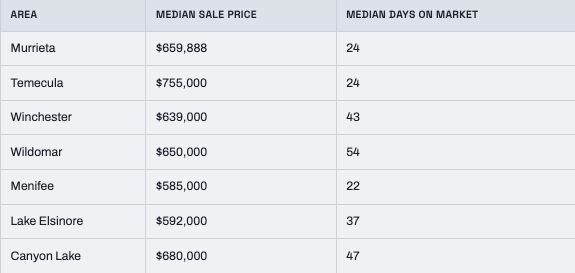
These are area-level medians for all residential sales, an individual luxury home's value varies significantly by condition, street, build year, and the specific features that matter to high-end buyers. The table is useful for understanding the regional landscape; it is not a substitute for a luxury-specific comparable analysis.
What the county assessment does, and doesn't, tell you
One of the most common mistakes I see luxury sellers make is anchoring their asking price to the county's assessed value. Under California's Proposition 13 framework, assessed value is determined by tax rules, generally set at the purchase price at the time of acquisition, with annual increases typically capped at 2%. It is not a live estimate of what your home would sell for today.
The 2026 Riverside County assessment roll totaled $483.98 billion in net taxable value, a 5.18% increase over the prior year, and reflects property values as of the January 1, 2026 lien date. That's a countywide tax-administration figure. It tells you nothing about what a buyer touring your Wine Country estate will offer in October 2026. Use the Riverside County Assessor-County Clerk-Recorder's property-sales report as a starting point for locating public-record transfers, then layer in the MLS data that reveals condition, concessions, marketing history, and days on market before the sale.
How do you build a credible luxury comparable analysis?
A credible luxury pricing analysis pulls from three data sources, and each one answers a different question. Closed sales tell you what buyers actually paid. Active listings show you the competition your buyer is weighing right now. Expired and withdrawn listings reveal what the market rejected, and why.
Matching comparables by property characteristics, not just city limits
For a luxury property in Temecula, the most relevant comparables are matched on the features that drive value in this specific segment. That means accounting for:
Lot size and usable acreage, a flat, usable acre commands a different premium than a steep or landlocked parcel of the same size
Views and privacy, ridge views, vineyard vistas, and setback from roads are quantifiable factors in buyer perception
Architectural quality and renovation level, a custom build with high-end finishes doesn't comp against a builder-grade home, even at the same square footage
Guest accommodations and ADUs, a detached guest house or permitted ADU expands the buyer pool and supports a higher price
Pool, outdoor improvements, and entertaining spaces, in Temecula's climate, a well-designed outdoor living area is a real value driver
Vineyard, winery, or equestrian features, these are niche amenities that attract a specific buyer and require comparables that reflect that buyer's willingness to pay
Proximity to amenities and major roads, Wine Country access, Old Town proximity, and freeway distance all affect perceived value
According to NAR research, luxury buyers are among the most informed and patient segments of the market, they're tracking inventory closely and they recognize when a property is priced above what the evidence supports. If you want to understand what separates a well-priced luxury listing from one that sits, the detail is in what makes luxury homes in Temecula distinct from the broader market.
How many comparables do you need?
In the luxury segment, you rarely have the volume of comparables that exist in the entry-level market. Recent local market data shows 522 active listings across Temecula and 388 homes sold in the trailing 90 days, but the luxury slice of that is a fraction of the total. When the pool is thin, the analysis has to go wider: extend the geographic radius to include comparable properties in Murrieta, unincorporated Riverside County, and Canyon Lake; extend the time window back 12-18 months where needed; and weight the most recent, most similar sales most heavily. Three or four well-matched closed sales are more useful than ten loosely matched ones.
What happens when a luxury home is priced too high from the start?
This is the question I spend the most time on with luxury sellers, because the consequences are real and often underestimated. When pricing luxury homes in Temecula for maximum impact, the launch price matters more than any subsequent adjustment. A property that opens materially above what the evidence supports generates fewer early showings, loses the burst of new-listing visibility that every property gets in its first two to three weeks, and then enters a cycle that's hard to break.
High-end buyers and their agents are watching the market closely. They notice when a listing sits. They notice when a price is reduced. And they draw a conclusion, not always a fair one, but a consistent one, that something is wrong with the property or that the seller is distressed. By the time the price reaches where it should have started, the buyers who would have been most excited on day one have already moved on.
The cost of getting the price wrong the first time isn't just a longer timeline, it's a negotiating position that weakens with every week the listing ages. I've seen sellers net less after a reduction than they would have if they'd priced it correctly at launch, because the eventual buyer had leverage that an early buyer wouldn't have had.
The CFPB's homeownership resources and NAR's housing statistics both point to the same dynamic at a national level: homes that require price reductions take longer to sell and often close at a lower final price than comparable homes that were correctly priced from day one. That pattern is amplified in the luxury segment, where the buyer pool is smaller and each potential buyer matters more.
When should you consider a price reduction?
If a luxury listing in Temecula has been on the market for 30-45 days without a serious offer, that's a signal worth examining. The question to ask is whether the lack of activity reflects price, condition, marketing, or access, and the answer determines the right response. A price reduction is the right tool when the evidence says you're above market. It's the wrong tool when the issue is presentation or exposure. That distinction is worth a conversation before you move the number.
For buyers on the other side of this equation, understanding how sellers think about pricing is covered in what buyers should know about luxury homes in Temecula.
FAQ
What is the best listing price for a luxury home in Temecula right now?
The right listing price is the one the evidence supports, built from verified closed sales of comparable luxury properties, adjusted for your home's specific features, and tested against what's actively competing for the same buyer. There is no single answer that applies to every property; a Wine Country estate with vineyard acreage prices differently than a custom home in a gated subdivision, even at similar square footage. The only way to get a defensible number is a property-specific analysis, not a market-wide median.
Should I price my luxury home high to leave room for negotiation?
Overpricing a luxury home to create negotiating room typically backfires. High-end buyers are well-researched and their agents are tracking the market closely, a price that sits above the evidence signals either a mispriced listing or a seller who isn't serious, and serious buyers often skip it entirely rather than negotiate down. Pricing luxury homes in Temecula for maximum impact means launching at a number that generates competitive early interest, not one that filters out your best buyers before they ever schedule a showing.
How long should a luxury home in Temecula stay on the market before reducing the price?
There's no universal rule, but 30-45 days without a serious offer on a well-marketed luxury listing is a meaningful signal. Before reducing the price, it's worth determining whether the issue is price, presentation, access, or marketing, those require different responses. If the comparable evidence points clearly to an overpriced position, an earlier, more decisive reduction is generally better than a series of small adjustments that extend the listing's age without resetting buyer perception.
Does a vineyard, guest house, pool, or view justify a higher asking price in Temecula?
These features can absolutely support a higher price, but only to the degree that comparable buyers have demonstrated they'll pay for them in closed sales. The premium for a vineyard or guest house is real in Temecula's Wine Country market, but it has to be grounded in what similar properties actually sold for, not in what the feature cost to build or what the seller believes it's worth. A well-documented comparable analysis is the only way to quantify the premium defensibly.
How is assessed value different from the right asking price for a luxury home?
Assessed value is a tax-administration figure determined under California's Proposition 13 framework, it's generally based on the purchase price at acquisition, with annual increases typically capped at 2%, and it reflects a lien date, not current market conditions. The asking price for a luxury home should be anchored to what buyers have actually paid for comparable properties in recent closed sales, adjusted for your home's specific characteristics. Using the county assessment as a pricing anchor is one of the most common and costly mistakes luxury sellers make.
Your specific number depends on your home's condition, features, location within Temecula Valley, and current buyer activity in your price band. That's exactly the kind of analysis I build before we ever agree on a number. Schedule a consultation and I'll walk you through a complete luxury pricing analysis for your property.
About Andrew Lewis
Andrew Lewis is a top-producing REALTOR® and founder of Performance Real Estate serving the Temecula Valley and greater Riverside County. Licensed since 2012, he has closed over 500 transactions totaling more than $200 million in sales, specializing in luxury homes, listings, new construction, relocation, and investor-focused real estate.
Real Broker · (951) 237-0292
Equal Housing Opportunity. Andrew Lewis, CA DRE, Performance Real Estate DRE 01914085 / 02022092, Real Broker, licensed by the California Department of Real Estate. This article is general information only and is not legal, tax, or financial advice; confirm your own figures with your closing agent, tax advisor, or lender.