Temecula buyers typically budget somewhere in the 2–5% range of the purchase price for closing costs, covering lender fees, escrow and title charges, Riverside County recording fees, and prepaid items like property taxes and insurance. The exact split between buyer and seller depends on what's negotiated in your purchase contract.
What do buyer closing costs cover in Temecula, CA?
Buyer closing costs in Temecula cover four main buckets: lender fees, escrow and title charges, Riverside County recording and government fees, and prepaid items like property taxes and homeowners insurance. Local lenders and agents commonly frame the total as somewhere in the 2–5% range of the purchase price, though the exact number depends on your loan type, lender, and what you negotiate with the seller in your contract.
Why the 2–5% Range Means Different Things at Different Price Points
Here's the first thing I tell every buyer who asks me about closing costs: the percentage is a starting point, not a promise. At a $400,000 purchase price, 2–5% is one conversation. At $700,000 or $760,000, right around where Temecula's median sits right now, it's a meaningfully larger number, and the composition of that figure matters as much as the total.
According to recent Zillow market data, the median sale price in Temecula is $760,000 as of August 2026, with homes averaging 28 days on market. Across the valley, prices vary enough that your closing cost picture shifts depending on where you're buying.
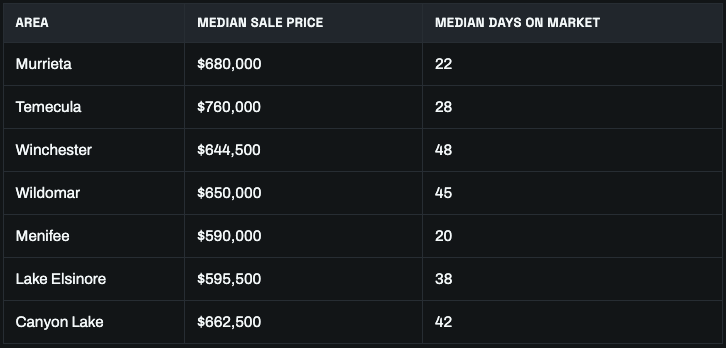
What that table tells you: a buyer in Menifee at $590,000 and a buyer in Temecula at $760,000 are dealing with the same four cost buckets, but the dollar amounts land differently. That's why I always walk my clients through the categories first, before we talk numbers, so they understand what they're actually paying for.
The Four Buckets Every Temecula Buyer Sees at Closing
1. Lender fees. These are the charges your mortgage lender collects to originate, underwrite, and fund your loan. On a purchase in Temecula, you'll typically see a loan origination or underwriting fee, an appraisal fee (paid to a local appraiser familiar with Riverside County values), a credit report fee, and potentially discount points if you've chosen to buy down your interest rate. The CFPB's Loan Estimate explainer breaks down exactly how these charges should appear on the form your lender is required to give you within three business days of application. Lender fees vary by institution and loan type, so comparing Loan Estimates from multiple lenders is one of the highest-leverage moves a Temecula buyer can make.
2. Title and escrow fees. In California, closings are coordinated by a closing agent, typically an escrow and title company. The 805 Title California closing costs guide notes that escrow fees generally scale with purchase price and are customarily split between buyer and seller, though that split is negotiable and should be confirmed in your contract. The buyer's side of the escrow fee covers the company's work coordinating your transaction. Separately, you'll pay for a lender's title insurance policy, which protects your lender's interest in the property. By California custom, the buyer pays for the lender's policy. The owner's title policy, which protects your equity, is customarily a seller expense in this market, but again: custom is not law. Your purchase contract controls.
3. Riverside County recording and government fees. When your deed and deed of trust are recorded with the county, Riverside County charges recording fees for each document. Per the Riverside County Assessor-County Clerk-Recorder, these fees are due at the time of recording. There's also a documentary transfer tax assessed at the county level. According to the Riverside County Clerk-Recorder FAQ, the rate is $0.55 per $500 of property value (or fractional part) for property in unincorporated areas and most cities in the county, including Temecula. This is the county rate only. Temecula does not layer an additional city transfer tax on top of it, unlike the City of Riverside, which charges $1.10 per $500. The county's ACR195 documentary transfer tax information sheet confirms the tax is due and payable at the time the deed is delivered for recordation, and the recorder will not process the document until it's paid. Who actually pays it is a contract question, not a statutory one. Some local contracts place it on the seller; in competitive situations, buyers sometimes cover it. There's no rule, only negotiation. California also requires a Documentary Transfer Tax Affidavit (ACR521) to accompany deed recordings. Your closing agent handles that paperwork, but the cost shows up on your closing disclosure.
4. Prepaids and impounds. This bucket surprises buyers more than any other. Prepaids are not fees for services rendered; they're money you're depositing in advance. You'll prepay mortgage interest from your closing date to the end of the month. You'll also fund an impound account to cover future property tax installments and homeowners insurance premiums. The Calclogix California Closing Costs Guide identifies prepaids as a consistent component of California buyer closing costs, and they can be a significant portion of your total, especially if you close early in the month (more days of prepaid interest) or if your property taxes are due soon after closing.
How the Split Actually Works in a Temecula Contract
California purchase contracts, including the standard California Association of REALTORS® forms used in most Temecula transactions, specify which party pays each closing cost line item. Some allocations follow strong local custom. Others are genuinely up for negotiation depending on market conditions and leverage.
Here's a practical summary of how costs typically land, with the caveat that every contract is different:
Lender fees: Buyer. These are your loan costs and don't transfer to the seller.
Lender's title insurance: Buyer, by California custom.
Owner's title insurance: Seller, by local custom in Riverside County, though negotiable.
Escrow fee: Commonly split between buyer and seller, per the California closing cost guidance from 805 Title.
Documentary transfer tax: Negotiable. No statutory default assigns it to one party. In Temecula, sellers often pay it, but this shifts in competitive offers.
Recording fees for the deed of trust: Often a buyer cost, since it's the buyer's loan instrument being recorded.
Prepaids and impounds: Buyer. These fund your own accounts and aren't a seller obligation.
If you're buying with an FHA or VA loan, the cost structure has additional nuances. The FHA program guidelines and VA home loan benefit information both address what fees are and aren't permissible for those borrowers to pay. Your lender should walk you through the specifics for your loan type.
One thing worth knowing if you're comparing notes with friends who bought in other states: California's closing process is different. Here, a neutral closing agent, not an attorney, coordinates the transaction. That's the norm in Southern California, and it's what you'll work with in Temecula.
Your specific number depends on your purchase price, loan type, lender, and what you negotiate in the contract. The only way to get a real figure is to run through it with a local lender and an agent who knows this market. I do this with every buyer before we start writing offers, because knowing your total cash-to-close number changes how you approach everything from your offer strategy to your down payment decisions.
If you're also curious about what sellers pay on the other side of the transaction, the cost to sell a house in Temecula Valley breaks that down in detail. And if you're a first-time buyer trying to get your footing, the guide to buying your first home in Temecula covers the broader process alongside the cost picture.
Frequently Asked Questions
Who pays escrow and title fees when I buy a home in Temecula?
By local custom in Riverside County, escrow fees are typically split between buyer and seller, and the owner's title insurance policy is usually a seller expense. The buyer pays for the lender's title insurance policy. That said, these are negotiable terms, not statutory requirements. Your purchase contract is what actually controls who pays what, so review it carefully with your agent.
Is the documentary transfer tax in Riverside County a buyer or seller cost?
Riverside County's documentary transfer tax is assessed at $0.55 per $500 of property value for Temecula transactions, per the Riverside County Clerk-Recorder. The county only requires that it be paid at recording. Who pays it is a matter of negotiation in the purchase contract. In many Temecula transactions, the seller covers it, but buyers sometimes absorb it in competitive offer situations.
Why do people say buyer closing costs are 2–5% in Temecula?
That range reflects the combined total of lender fees, escrow and title charges, Riverside County recording and government fees, and prepaid items like property taxes and homeowners insurance. It's a useful planning benchmark, not a fixed number. Your actual costs depend on your loan type, lender, purchase price, and what's negotiated in the contract. At Temecula's current median of $760,000, even a fraction of a percentage point makes a real difference in your cash-to-close total.
Do Temecula buyers pay for both owner's and lender's title insurance?
By California custom, the buyer pays for the lender's title insurance policy (which protects the lender's interest in the loan), while the owner's title policy (which protects your equity) is customarily paid by the seller. This split is common in Riverside County transactions but is still a negotiable term in the purchase contract, not a legal requirement.
What lender fees should I expect on a mortgage for a $700,000 Temecula home?
On a $700,000 purchase, your lender's fees will typically include an origination or underwriting charge, an appraisal fee, a credit report fee, and potentially discount points if you choose to buy down your rate. The CFPB's Loan Estimate guide explains how these should appear on the disclosure your lender provides within three business days of application. Comparing Loan Estimates from multiple lenders is one of the most effective ways to reduce your total cost.
Know Your Numbers Before You Make an Offer
Closing costs aren't a mystery once you know the categories and who typically pays what in a Temecula contract. The real work is getting a lender's Loan Estimate and running through the numbers with an agent who can tell you what's negotiable and what isn't in this specific market.
I'm happy to walk you through a full buyer cost breakdown before you start your search. Schedule a consultation here and we'll map out your total cash-to-close picture so there are no surprises at the finish line.
About Andrew Lewis
Andrew Lewis is a top-producing REALTOR® and founder of Performance Real Estate serving the Temecula Valley and greater Riverside County. Licensed since 2012, he has closed over 500 transactions totaling more than $200 million in sales, specializing in luxury homes, listings, new construction, relocation, and investor-focused real estate.
Real Broker · (951) 237-0292
Equal Housing Opportunity. Andrew Lewis, CA DRE. Performance Real Estate DRE 01914085 / 02022092, Real Broker. This article is general information only and does not constitute legal, tax, or financial advice. Confirm your specific closing costs and obligations with your closing agent, tax advisor, or lender. California Department of Real Estate.