Lake Elsinore Storm games bring 100,000+ fans through the city each season, creating recurring foot traffic, downtown spending, and lifestyle visibility that can strengthen listing narratives and short-term rental demand near the stadium, though proximity alone doesn't change appraised value.
Do Lake Elsinore Storm games actually affect nearby real estate?
Minor league baseball doesn't move the needle on appraised value the way a school or freeway interchange might, but the Storm create something real: a predictable, seasonal pattern of people, spending, and attention that makes Lake Elsinore easier to market and easier to live in. For buyers, sellers, and anyone thinking about a short-term rental near the stadium, that pattern is worth understanding before you make a decision.
What the Storm actually bring to Lake Elsinore
The Lake Elsinore Storm are a Single-A affiliate of the San Diego Padres, playing home games at Lake Elsinore Diamond, a 7,866-seat stadium that opened in 1994 just east of Interstate 15. That location matters: it puts game-day traffic directly through the city's commercial corridors and downtown retail zones.
The most recent full-season attendance figures available, from the 2024 season, show total home attendance of 102,920, averaging roughly 1,560–1,600 fans per game. As a California League club, the Storm typically run 60–70 home games concentrated between April and September, clustered in multi-day homestands. That's not one big event, it's a repeating weekly pattern across six months.
Those fans aren't all locals. A meaningful share drives in from Temecula, Murrieta, Menifee, and other parts of the Valley, which means the stadium draws regional visitors into Lake Elsinore's dining scene, gas stations, and retail strips on a regular schedule. For the city's economic visibility, that matters.
Game-day traffic: headache or lifestyle perk?
I'll give you the honest answer: it depends on exactly where you are. Homes within a few blocks of the stadium will see pre- and post-game traffic on game nights. Homes a mile or two away barely notice it. The key framing I use with buyers is that this is seasonal and predictable, not year-round congestion. Non-game days feel like any other Inland SoCal suburb. Game nights add a short burst of energy and cars, which most residents experience more as event buzz than daily frustration.
If you're a buyer who values walkable entertainment and affordable sports outings, that buzz is a genuine lifestyle plus. If you're more traffic-sensitive, you can still be close enough to attend games easily without being right on top of the parking flow. That's a real nuance, and it's worth talking through before you write an offer on a specific street.
The short-term rental angle
There are no verified STR occupancy numbers tied specifically to Storm games, so I'm not going to pretend otherwise. What the data does support is a reasonable premise: six months of recurring game-day visitors, combined with Lake Elsinore's position between Inland Empire cities, Temecula wine country, and San Diego County, creates multiple reasons for overnight stays in the area. A visitor can pair a Storm game with a Temecula wine tasting, a day on the lake, or Old Town Temecula dining, the geography makes multi-night trips logical.
For owners of legally-permitted short-term rentals or ADUs near the stadium, baseball season adds a marketing hook. Framing a listing as convenient for Storm fans and Temecula Valley weekend getaways is honest and specific. Just don't confuse "demand driver" with "guaranteed income", STR performance depends on your platform, pricing, property condition, and local permit status, none of which I can assess from a blog post.
What the Lake Elsinore market looks like right now
Recent local market data (trailing approximately 90 days as of September 2026) puts the Lake Elsinore median sale price at $595,500, with a median of 40 days on market and 227 active listings currently available. About 285 homes closed in the last 90 days, with 92 new listings coming on in the past 30 days alone. That's an active, mid-sized market, not stagnant, but not the frenzied pace of some neighboring cities either.
Here's how Lake Elsinore compares across the broader Temecula Valley right now, using the same trailing-90-day data:
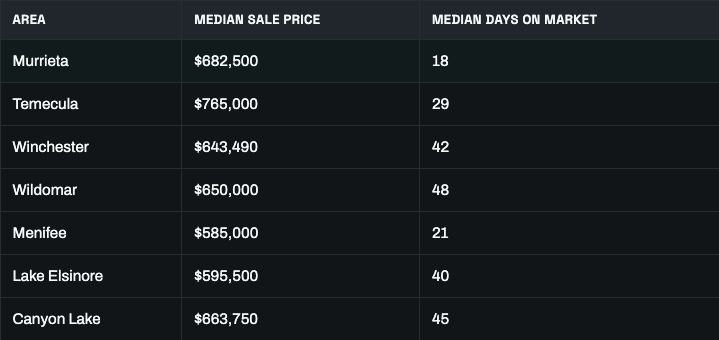
Lake Elsinore's median sits near the lower end of the Valley, which makes it one of the more accessible entry points in the region. The 40-day median is longer than Murrieta or Menifee, which tells me that pricing and presentation still matter here, homes that are well-positioned move, and homes that aren't sit. That's exactly where a strong lifestyle narrative around the Storm, the lake, and regional access can help a listing stand out.
Across the broader Temecula Valley, Redfin's market data through late August 2026 shows a near-flat to slightly soft price environment year-over-year, with homes in Temecula going pending in roughly 29 days. The most recent local market analysis from August 2026 notes that average days on market in Temecula actually improved from about 40 days to 34 days year-over-year, suggesting the market is absorbing inventory efficiently even as price growth has cooled. Multiple 2026 reports also show fewer new listings compared to 2025, in August, Temecula saw 182 new listings versus 189 the year before, meaning buyers have fewer options and sellers who market well have an edge.
When amenities matter most to buyers
When inventory is tight and price growth is modest, buyers weigh lifestyle factors more heavily. I see this consistently: a buyer choosing between two similarly-priced homes in Lake Elsinore will often lean toward the one where the agent has painted a clear picture of daily life, lake access, a ten-minute drive to a Storm game, Old Town Temecula on a Friday night. That's not fluff. It's the difference between a listing that sits at 40 days and one that gets an offer in two weeks.
The Storm's consistent six-figure annual attendance and nearly 8,000-seat stadium position Lake Elsinore Diamond as a stable, long-term entertainment anchor, not a pop-up attraction. Paired with Temecula Valley's established wine country, Pechanga Resort, and the lake itself, the Storm are part of a regional identity centered on accessible weekend experiences. That identity holds real appeal for buyers relocating from higher-cost metros who are choosing neighborhoods based on lifestyle, not just commute times.
If you're selling near the stadium, lean into it. Include the Storm schedule in your listing description, especially for out-of-area buyers considering the Valley for a primary home, second home, or hybrid work setup. Describe it honestly: seasonal, predictable, family-oriented, affordable. That's a story that resonates with a lot of buyers right now.
If you want to know how to position your specific home, or whether your street is close enough to the stadium to use it as a marketing asset versus something to address proactively, that's a conversation worth having before you list. Every block is a little different, and I'd rather walk you through it now than have it come up during negotiations.
For more on how Lake Elsinore compares to neighboring cities on price, lifestyle, and value, see my posts on Lake Elsinore vs. Wildomar and moving to Murrieta or Lake Elsinore.
Frequently Asked Questions
How busy does Lake Elsinore get around Storm home games, and does that affect living near the stadium?
Game nights bring a noticeable increase in traffic and foot traffic near Lake Elsinore Diamond and the surrounding commercial corridors, but the impact is time-bound to pre- and post-game windows during the April-through-September baseball season. Most residents describe it as event buzz rather than daily congestion. Homes within a few blocks feel it most; homes a mile or two away barely notice it.
Does minor league baseball season make it easier to rent out a home or ADU near Lake Elsinore Diamond?
Baseball season adds a recurring demand signal for short-term rentals in the area, particularly when combined with Lake Elsinore's proximity to Temecula wine country, the lake, and San Diego County. There are no publicly verified STR occupancy numbers tied specifically to Storm games, but the seasonal pattern of 100,000+ visitors across roughly 60–70 home dates gives owners of legally-permitted rentals a legitimate marketing hook. Actual performance depends on your platform, pricing, and property details.
Are homes near the Storm stadium worth more because of the entertainment access?
Proximity to the stadium doesn't directly change a home's appraised value, but it can influence how quickly and how competitively a home sells by making the lifestyle narrative stronger. In a market where Lake Elsinore's median days on market sits at 40 days, a well-told amenity story, Storm games, lake access, wine country nearby, can be the difference between a listing that moves fast and one that sits. It's a marketing advantage, not a line item on an appraisal.
If I buy in Temecula Valley, will game-day traffic from the Storm be a headache or a lifestyle perk?
For most of the Valley, game-day traffic from the Storm is essentially invisible, the stadium is in Lake Elsinore, and the traffic impact concentrates near the stadium and downtown, not across Temecula or Murrieta. If you're buying specifically in Lake Elsinore near the stadium, it's a seasonal, predictable pattern that many residents enjoy. If you're traffic-sensitive, there are plenty of Lake Elsinore neighborhoods close enough to attend games easily without being in the parking flow.
How should I highlight nearby Storm games when marketing my Lake Elsinore home for sale?
Include the Storm in your listing description as part of a broader lifestyle picture: minor league baseball within minutes, lakefront recreation, and Temecula wine country a short drive away. Frame it honestly as seasonal and family-friendly. Out-of-area buyers considering the Valley for a primary home, second home, or hybrid work setup often respond well to that kind of specific, experiential detail, it helps them picture daily life in a way that "great location" never does. I walk sellers through exactly how to build that narrative before we go live.
The bottom line
The Storm aren't going to single-handedly move Lake Elsinore's median price, but they're a real, recurring asset that makes the city easier to market and more enjoyable to live in. In a market where presentation and positioning matter, that's worth using. If you're buying or selling near the stadium and want to talk through what it means for your specific situation, reach out and let's run the numbers together.
Schedule a consultation with Andrew Lewis
About Andrew Lewis
Andrew Lewis is a top-producing REALTOR® and founder of Performance Real Estate serving the Temecula Valley and greater Riverside County. Licensed since 2012, he has closed over 500 transactions totaling more than $200 million in sales, specializing in luxury homes, listings, new construction, relocation, and investor-focused real estate.
Real Broker · (951) 237-0292
Equal Housing Opportunity. Andrew Lewis, CA DRE, Performance Real Estate DRE 01914085 / 02022092, Real Broker. This article is general information only and does not constitute legal, tax, or financial advice. Confirm your specific numbers with your closing agent, tax advisor, or lender. California Department of Real Estate.