Temecula Valley offers larger homes, lower prices than coastal Southern California, and a suburban lifestyle centered on wine country, family amenities, and I-15 freeway access. Trade-offs include longer commutes to San Diego or Orange County job centers and a car-dependent daily routine.
What should I expect when relocating to Temecula Valley?
Temecula Valley offers a suburban lifestyle with more home for your money than coastal Southern California, a strong family-oriented community, and a distinctive local culture built around wine country, Old Town, and year-round outdoor living. The real trade-offs are commute time and a higher overall cost of living than most of the country, so coming in with clear expectations makes all the difference.
I've helped hundreds of relocating buyers land in this market, and the ones who thrive here are the ones who understood what daily life actually looks like before they signed anything. This post gives you that honest picture.
The Basics: Location, Growth, and Who Lives Here
Temecula sits in southwestern Riverside County, right at the intersection of the Inland Empire and North County San Diego. Interstate 15 is the spine of daily life here, it connects you north toward Murrieta, Corona, and Orange County, and south toward Escondido and San Diego. That geography shapes nearly everything about living in the valley.
The city has grown steadily but not explosively. According to the U.S. Census Bureau QuickFacts, the 2024 population estimate for Temecula was 112,431. The City of Temecula's 2025 Pop-Facts Demographics report puts the 2025 estimate at 113,315, with a 2030 projection of 114,081, modest, steady growth rather than boom-and-bust expansion.
The community skews younger than many California cities. The 2025 City Summary reports a median age of 37.5, and Neilsberg's 2025 age-distribution analysis shows that 28.1% of residents are under 18. That's nearly one in three people, which tells you a lot about what the community prioritizes.
On the income side, Temecula is an affluent suburb. The city's own 2025 demographic report lists a 2025 estimated median household income of $115,071 and an average household income of $145,129. That's well above national norms, and it reflects the professional households that make up much of the valley's population.
Community makeup
According to Neilsberg's 2025 race and ethnicity update (based on ACS 5-year estimates), Temecula's population is approximately 57% White, 28.5% Hispanic or Latino, 11.5% Asian, and 4.3% Black or African American, with roughly 26% identifying as multiracial or another race. Cultural life in the valley shows up in its festivals, farmers markets, and community events more than in large urban institutions, residents typically travel to San Diego, Riverside, or Los Angeles for major concerts or performing arts.
The 2025 Pop-Facts report also notes that about 80% of Temecula's 36,914 households are family households. That's an unusually high share, and it shapes the entire feel of the community.
Daily Life: Commutes, Amenities, and the Car-Dependent Reality
The commute question
This is the one I get asked about most by relocating buyers, and I always give them the same honest answer: Temecula is a bedroom community. If your job is in San Diego, Orange County, or Riverside, you will be commuting on I-15, and depending on where you're headed and what time you leave, that can run anywhere from 45 minutes to well over 90 minutes each way.
Public transit is limited. Most residents rely entirely on personal vehicles. Bus service and park-and-ride options exist through regional agencies, and rail access typically means driving to a Metrolink or Coaster station in an adjacent city. If you're used to a walkable urban commute, this is a genuine lifestyle shift worth thinking through carefully before you commit.
The flip side: many people who work locally in Murrieta, Temecula, or the surrounding valley find the commute a non-issue. And for remote workers, Temecula has become increasingly popular precisely because you get more home for your money without the penalty of a daily freeway grind.
What daily life actually looks like
Daily life here is car-centric and suburban. Retail and dining are concentrated around major corridors, the Promenade Temecula area, the Margarita Road corridor, and the Highway 79 South corridor are your go-to zones for big-box stores, chain restaurants, and local spots. You're not walking to a coffee shop from your front door; you're driving five minutes to one.
Old Town Temecula is the exception. It's a genuine walkable district with Western-influenced architecture, boutique shops, wine-tasting rooms, and restaurants that draw both residents and tourists. Weekend evenings in Old Town have a small-town energy that a lot of people find refreshing after years in bigger cities. If you want a taste of what it's like, check out my post on things to do in Temecula.
Temecula Valley Wine Country is a legitimate lifestyle perk, not just a marketing line. Dozens of wineries, tasting rooms, hot-air balloon rides, and agritourism events are woven into the social calendar here. Residents don't just visit wine country on special occasions, it becomes part of regular weekend life.
Summer heat is real. Inland temperatures regularly push into the 90s and above, and wildfire smoke can affect air quality during fire season. The South Coast Air Quality Management District is the right place to check current conditions and historical data if air quality is a health consideration for your household. The EPA's outdoor air quality data portal also provides regional AQI tracking.
The housing market in context
Recent Zillow market data (trailing approximately 90 days as of August 2026) shows a median sale price of $760,000 in Temecula, with homes spending a median of 29 days on market. There are currently 511 active listings across the area, and 406 homes have sold in roughly the past 90 days, a market that's active but not frenzied.
If you're comparing across the valley, here's how the surrounding communities stack up on the same data set:
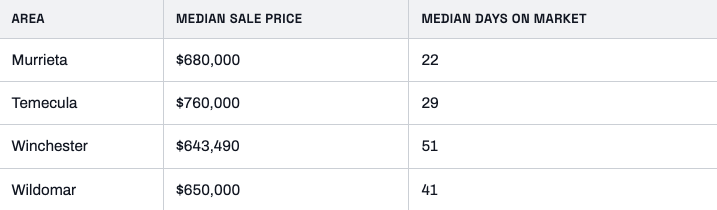
These are area-level medians, an individual home's value depends on condition, street, build year, and timing. But the table gives you a useful orientation: Murrieta tends to move faster and at a lower median price, while Winchester and Wildomar offer more breathing room on both price and pace. For a deeper look at Murrieta specifically, I put together a full guide to living in Murrieta that covers neighborhoods, commutes, and what to expect day-to-day.
The housing stock is dominated by single-family homes in HOA-managed master-planned communities, most built from the late 1990s through the 2010s. You'll find cul-de-sacs, three- and four-car garages, and larger lot sizes than you'd get at comparable price points in San Diego or Orange County. Semi-rural lots and custom homes exist on the valley's outskirts and in wine country. Townhomes and apartments are available but represent a smaller share of the overall market than in denser coastal cities.
For context on what the ACS-based data shows: the RelocateFacts 2026 cost-of-living summary for Temecula cites a median home value of $604,300 and median gross rent of $2,222 from the Census Bureau's ACS 5-year estimates (2018-2022 survey window). Those figures are not current market prices, the Zillow data above is more current, but they confirm the general structure of a mid-to-upper price point housing market.
Cost of Living: What the Numbers Mean for Your Budget
Temecula is not cheap. LivingCost.org's 2026 analysis estimates an average cost of living of about $2,690 per month for a single person, placing Temecula in the top 6% most expensive cities globally, while also giving it a quality-of-life score of 84 out of 100. Those two facts aren't contradictory; they describe the same reality from different angles.
The practical framing for relocators: Temecula is expensive compared with most of the U.S., but meaningfully more attainable than San Diego, Orange County, or Los Angeles coastal communities. Groceries, utilities, and gasoline track Southern California prices generally. Housing is the biggest line item, followed by transportation (you will be driving, and gas costs add up). Childcare, if that's relevant to your household, will also be a significant budget driver.
According to the Bureau of Labor Statistics' California regional data, Southern California consistently ranks among the highest cost-of-living regions in the country, Temecula sits within that broader picture but toward the more accessible end of the spectrum for the region.
The U.S. Census Bureau's American Community Survey data (2018-2022 estimates) puts Temecula's median household income at $111,881, consistent with the city's own 2025 estimate of $115,071. That income level supports the housing market here, but it also means the market is priced for dual-income professional households in many cases. If you're relocating from a lower cost-of-living area, the adjustment is real and worth modeling out carefully before you commit to a price range.
Every situation is different, and the only way to know what you can realistically afford in this market is to run the numbers with someone who knows it. That's a conversation I have with every relocating buyer before we ever look at a single home.
Frequently Asked Questions
Is Temecula Valley more affordable than coastal Southern California cities like San Diego or Orange County?
Yes, in relative terms. Recent Zillow market data shows a median sale price of $760,000 in Temecula, compared with significantly higher medians in coastal San Diego and Orange County markets. You typically get more square footage and lot size for your dollar in the Temecula Valley, which is a primary driver for relocating households. That said, Temecula is still expensive by national standards, so "more affordable" is a comparison to coastal California, not to the broader U.S.
What is the commute really like from Temecula to San Diego, Orange County, or Riverside?
Honest answer: it's long. I-15 is the main artery, and commutes to downtown San Diego or Orange County job centers routinely run 60 to 90-plus minutes each way depending on traffic and time of day. Riverside is closer and more manageable. Public transit options are limited, so virtually all commuting is by personal vehicle. Many residents accept the commute as the trade-off for larger homes and a lower price point than coastal cities, but it's a significant lifestyle factor to weigh before you decide.
How family-oriented is Temecula Valley in terms of parks, activities, and community feel?
Very. According to the City of Temecula's 2025 demographic data, about 80% of households are family households, and roughly 28% of the population is under 18. Youth sports leagues, community parks, and structured activities are central to weekend life here. The Temecula Valley Unified School District is frequently cited as a draw for relocating families, for specific performance data, the California Department of Education is the authoritative source for current school metrics.
What kind of lifestyle does Temecula offer, suburban, rural, or small-town?
Primarily suburban, with genuine small-town character in Old Town Temecula and a rural/agritourism feel in the wine country corridor. Most of the city is master-planned HOA communities with all the suburban amenities you'd expect. The combination of wine country, outdoor recreation, and a walkable Old Town gives Temecula a more distinctive identity than a typical inland suburb, but daily life still revolves around driving, big-box retail, and car-centric infrastructure.
What are typical housing options in Temecula Valley, and how competitive is the market?
Single-family homes dominate, most built from the late 1990s through the 2010s in HOA communities. Townhomes and apartments exist but are a smaller share of the market. Recent Zillow data shows a median sale price of $760,000 in Temecula and a median of 29 days on market, with 511 active listings and 406 homes sold in the past 90 days, active but not the frenzied pace of a few years ago. Neighboring Murrieta moves faster at a lower median ($680,000, 22 days), while Winchester and Wildomar offer more time and slightly lower price points.
The Bottom Line on Relocating to Temecula Valley
Temecula Valley delivers a genuine quality of life, larger homes, wine country, a strong family community, and a more attainable price point than the coast, in exchange for longer commutes, car-dependent daily living, and a cost of living that's high by national standards. Whether that trade-off works for your household depends entirely on your job location, lifestyle priorities, and budget.
I've been helping relocating buyers navigate this market since 2012, and the difference between a smooth move and a frustrating one almost always comes down to understanding what daily life actually looks like before you commit. If you're weighing Temecula Valley as your next home base, I'd rather spend 30 minutes walking you through the real picture than have you discover the trade-offs after you've already signed.
Ready to talk through whether Temecula Valley is the right fit? Schedule a relocation consultation with my team and we'll map out your options across the valley, no pressure, just a real conversation.
About Andrew Lewis
Andrew Lewis is a top-producing REALTOR® and founder of Performance Real Estate, serving the Temecula Valley and greater Riverside County. Licensed since 2012, he has closed over 500 transactions totaling more than $200 million in sales, specializing in luxury homes, listings, new construction, relocation, and investor-focused real estate.
Real Broker · (951) 237-0292
Performance Real Estate DRE 01914085 / 02022092 | Real Broker | Andrew Lewis CA DRE License | Equal Housing Opportunity. This article is general information only and does not constitute legal, tax, or financial advice. Confirm your specific costs and circumstances with your attorney, tax advisor, lender, or escrow officer. California Department of Real Estate, dre.ca.gov.