By Andrew Lewis
Wildfire risk in Temecula Valley varies sharply by micro-location, and California home insurance premiums have risen 84% statewide over five years. Buyers and owners need to check a property's Fire Hazard Severity Zone designation, understand FAIR Plan options, and factor insurance costs into any purchase or ownership decision.
How does wildfire risk affect home insurance in Temecula Valley?
Wildfire risk in Temecula Valley varies significantly depending on a property's exact location, with rural areas like De Luz, Rainbow, and Wine Country carrying much higher exposure than suburban neighborhoods. According to a July 2026 Stanford research analysis covered by ABC7 News, average California home insurance premiums have risen 84% over the past five years, with the steepest increases in high-risk fire zones. For Temecula Valley buyers and homeowners, that means insurance isn't a line item to figure out after escrow, it's a due-diligence step that belongs at the front of the process.
The Wildfire Landscape in Temecula Valley Right Now
Temecula Valley sits in Riverside County, and the county's fire exposure is serious. A Fire & Safety Journal Americas analysis reports that FEMA assigns Riverside County a maximum wildfire risk score of 100%, with projected annual wildfire-related losses of roughly $319 million and more than 70% of structures facing some level of wildfire damage risk. Those are county-level figures, not Temecula-specific, but they reflect the regional environment your home sits in.
Within the Valley, risk is not evenly distributed. Suburban neighborhoods with wide streets, irrigated landscaping, and close fire station proximity look very different to an underwriter than a custom home on a canyon lot in De Luz or a rural parcel backing onto chaparral in the hills above Wine Country. That micro-geography matters enormously for what coverage you can get and what you'll pay for it.
Recent fires have reinforced how quickly conditions can escalate. The Nixon Fire, documented in 2024 regional reporting, threatened more than 1,700 structures east of Temecula and prompted evacuation centers at Temecula Valley High School. More recently, smaller fires sparked and faded around Temecula during 2025 heatwaves, with triple-digit temperatures and low humidity creating dangerous conditions. These aren't hypothetical risks, they're documented events in our backyard.
How to Check a Property's Fire Hazard Severity Zone
Before you make an offer on any Temecula Valley property, check its official Fire Hazard Severity Zone (FHSZ) designation. CAL FIRE's GIS mapping and data analytics tools let you look up a specific parcel and see whether it falls into a Moderate, High, or Very High hazard zone. That designation will shape what insurers are willing to write, what disclosures are required, and what mitigation steps matter most.
I walk every buyer I work with through this lookup before we get deep into escrow. A "Very High" designation on a property you're under contract on isn't necessarily a dealbreaker, but you need to know about it early enough to shop insurance, understand your options, and factor the cost into your decision.
For context on what the market looks like right now: recent Zillow market data shows Temecula's median sale price at $765,000, with homes selling in a median of 26 days and 504 active listings currently available. At that price point, a meaningful insurance premium increase, or a forced move to the FAIR Plan, can shift your monthly carrying costs enough to matter. You can also explore the full picture of ownership costs in Temecula before committing.
What the Insurance Market Actually Looks Like for Temecula Homeowners
The statewide insurance crisis is real, and Temecula Valley isn't immune. Major carriers have reduced their California exposure, and properties in or near high-hazard zones are the first to feel it through non-renewals, coverage restrictions, or premiums that have jumped dramatically at renewal.
The FAIR Plan: What It Is and What It Isn't
If a traditional carrier declines to write your property, the California FAIR Plan is the state's insurer of last resort for basic fire coverage. It covers fire, smoke, lightning, and internal explosion, but it does not cover liability, water damage, theft, or most of the other perils in a standard homeowners policy.
For that reason, homeowners in higher-risk Temecula Valley areas increasingly use a two-policy structure: a FAIR Plan policy for fire coverage paired with a separate "difference in conditions" (DIC) or wrap policy from another carrier that fills in the gaps. It's a workable solution, but it typically costs more than a single standard policy and adds complexity to your coverage management. If you're buying in De Luz, rural Winchester, or anywhere near open space, ask your insurance broker specifically about this structure before close of escrow.
New State Laws That Took Effect in 2026
The regulatory environment is shifting in ways that matter for Temecula homeowners. According to the California Wildfire Safety and Preparedness Task Force, three new laws sponsored by the Insurance Commissioner took effect on January 1, 2026, targeting home hardening, insurance access in high-risk areas, and wildfire risk transparency. The intent is to create a clearer link between mitigation measures and insurers' willingness to write or renew coverage.
The California Department of Insurance tracks wildfire-related non-renewals and market stress by county, including Riverside County data. If you want to understand the systemic trend, not just your individual renewal, that's the authoritative source to check.
Non-Renewal Moratoriums: Are Temecula ZIP Codes Protected?
California law provides a mandatory one-year moratorium on non-renewals and cancellations for residential policies in ZIP codes near a Governor-declared state of emergency. The protection is real, but it's incident-specific and time-limited. It only applies when your specific ZIP code is named in a moratorium issuance tied to a declared fire emergency.
As of the posted CDI list, recent moratoriums have covered fires in other parts of California, not Temecula ZIP codes specifically. That means Temecula homeowners don't currently have active moratorium protection unless a new fire emergency changes that. The right move is to check the CDI's moratorium page directly if a fire event occurs near your property, and to contact the Department's consumer line if you receive a non-renewal notice.
The North County Fire Protection District also maintains guidance for homeowners navigating insurance in high-risk areas, including referrals to CDI resources.
Home Hardening: What Actually Moves the Needle
Mitigation measures are increasingly a factor in whether a carrier will write your policy and at what rate. The Wildfire Task Force's 2026 guidance explicitly ties home-hardening improvements to improved insurance access. Here's what matters most for Temecula Valley properties in or near high-hazard areas:
Roof material: Class A fire-rated roofing (composition shingles, tile, metal) is the baseline. Untreated wood shakes are a red flag for insurers.
Vents and eaves: Ember intrusion through open vents and eaves is a leading cause of home ignition. Enclosed eaves and ember-resistant vent screens make a documented difference.
Defensible space: Cleared zones around the structure, typically 0-30 feet and 30-100 feet, reduce direct flame contact and radiant heat exposure.
Exterior materials: Non-combustible siding and deck materials reduce ignition risk from embers landing on the structure.
Access and water supply: For rural parcels, driveway width, turnaround space for fire apparatus, and access to water sources (tanks, pools, or hydrants) factor into both fire agency response and insurer assessments.
If you're buying a property in a high-risk area, ask the seller about any completed home-hardening improvements and request documentation. Those upgrades can affect your insurance options from day one of ownership.
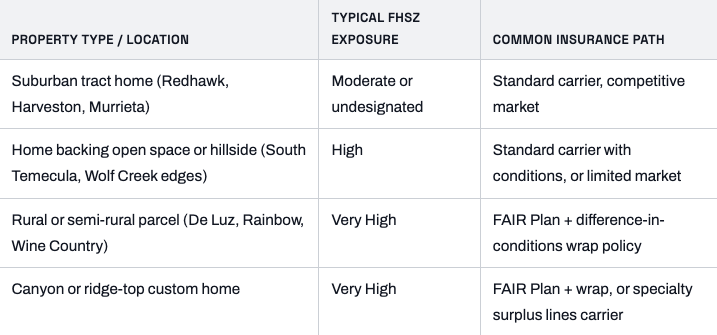
This table reflects general patterns based on FHSZ mapping and local market conditions, individual properties vary, and the only way to know your specific situation is to get a quote from a licensed insurance broker who works in Riverside County.
What Buyers and Sellers Need to Do Before Closing
If you're buying in Temecula Valley right now, insurance due diligence isn't optional. Here's the sequence I walk my clients through:
Check the FHSZ designation on the specific parcel using CAL FIRE's mapping tools before making an offer or at minimum before removing contingencies.
Contact an insurance broker early, not after you're in contract. In a high-risk zone, getting bindable quotes can take longer than a standard property, and you don't want to discover an insurability problem at the last minute.
Ask the seller for insurance history, prior claims, non-renewal notices, or a current FAIR Plan policy are all signals worth understanding before you take title.
Budget for the real cost, not a placeholder. If the property is in a Very High zone, get actual quotes for a FAIR Plan plus wrap structure and use those numbers in your affordability math. My post on the hidden costs of living in Temecula covers this alongside other ownership expenses worth knowing upfront.
Verify any moratorium status if a fire event has recently occurred near the property. Start at the CDI moratorium page and confirm your ZIP code is included before relying on that protection.
For sellers, wildfire risk and insurance availability are increasingly part of the buyer conversation. Homes in high-risk areas that have documented hardening improvements, a current FAIR Plan policy in place, and clear defensible space tend to face fewer surprises during escrow. If your property is in or near a high-hazard zone, having that documentation ready before you list is worth the effort.
Frequently Asked Questions
Is it getting harder to find homeowners insurance in Temecula because of wildfire risk, or is that mostly Wine Country and De Luz?
The hardest-hit areas for insurance availability are properties in or near Very High Fire Hazard Severity Zones, which does include Wine Country, De Luz, and rural canyon areas more than suburban Temecula proper. That said, statewide premiums have risen 84% over five years, and even lower-risk suburban properties are seeing higher rates at renewal. The gap between suburban and rural risk is real, but no part of Temecula Valley is fully insulated from the broader market trend.
How do I check if a Temecula property is in a Very High Fire Hazard Severity Zone before I make an offer?
Use CAL FIRE's GIS mapping tools to look up the specific parcel's Fire Hazard Severity Zone designation. The maps classify terrain as Moderate, High, or Very High. I recommend doing this lookup before you make an offer, not after, it affects your insurance options and should factor into your due diligence timeline.
What does the California FAIR Plan actually cover for a high-fire-risk home near Temecula?
The FAIR Plan provides basic fire coverage: fire, smoke, lightning, and internal explosion. It does not cover liability, water damage, theft, or the broader perils included in a standard homeowners policy. Most homeowners in high-risk Temecula Valley areas who rely on the FAIR Plan pair it with a separate "difference in conditions" or wrap policy from another carrier to fill those gaps. It's a workable structure but typically more expensive and more complex than a single standard policy.
Can my insurance company drop my Temecula policy because of wildfire risk, and is there any protection against that?
Yes, insurers can non-renew policies in high-risk areas, though California law provides a mandatory one-year moratorium on non-renewals for ZIP codes near a Governor-declared state of emergency. The protection is incident-specific, it only applies when your ZIP code is explicitly named in a moratorium tied to a declared fire. As of mid-2026, no active moratoriums cover Temecula ZIP codes, but that can change if a major fire occurs nearby. Check the CDI moratorium page and contact their consumer line if you receive a non-renewal notice.
What home-hardening upgrades make the biggest difference for insurance options in Temecula Valley?
The upgrades that matter most to insurers are Class A fire-rated roofing, ember-resistant vents and enclosed eaves, non-combustible exterior materials, and maintained defensible space (cleared zones around the structure). For rural properties, driveway access for fire apparatus and reliable water supply also factor in. The California Wildfire Task Force's 2026 guidance explicitly ties these improvements to better insurance access, documented upgrades can open doors to carriers that would otherwise decline the property.
Wildfire risk in Temecula Valley is real, location-specific, and directly connected to what you'll pay for insurance, or whether you can get standard coverage at all. The good news is that with the right information upfront, buyers and homeowners can navigate this without surprises.
If you're buying, selling, or just trying to understand how your property's risk profile affects your options, I'm happy to walk through it with you. Schedule a consultation here and we'll look at your specific situation together.
About Andrew Lewis
Andrew Lewis is a top-producing REALTOR® and founder of Performance Real Estate, serving the Temecula Valley and greater Riverside County. Licensed since 2012, he has closed over 500 transactions totaling more than $200 million in sales, specializing in luxury homes, listings, new construction, relocation, and investor-focused real estate.
Real Broker · (951) 237-0292
Equal Housing Opportunity. Andrew Lewis, CA DRE, Performance Real Estate DRE 01914085 / 02022092, Real Broker, regulated by the California Department of Real Estate. This article is general information only and does not constitute legal, tax, or financial advice; confirm your specific insurance, cost, and coverage details with a licensed insurance broker, attorney, tax advisor, or escrow officer.