Yes, you can still sell a Temecula Valley home when you owe more than it's worth. A short sale lets you sell with lender approval, accepting less than the full payoff to release the lien. It takes longer than a standard sale, but it's a real path out, and often better than foreclosure.
Can you sell a home in Temecula Valley if you owe more than it's worth?
Yes. Being underwater on your mortgage doesn't mean you're stuck. In California, you can still sell your home through a process called a short sale, where your lender agrees to accept less than the full loan payoff and releases the lien so the transaction can close. It's more complex than a standard sale, but it's a viable path, and for many homeowners, it's far less damaging than letting the property go to foreclosure.
First, Know Where the Local Market Stands
Before you assume you're underwater, it's worth checking what your home would actually sell for today. The Temecula Valley market has held up better than many people expect. According to recent Zillow market data, the median sale price in Temecula is currently $775,000, with homes selling in a median of 28 days. There are 507 active listings on the market, 170 new listings in the last 30 days, and 402 homes sold in roughly the last 90 days. That's a functioning, active market.
That said, median figures are area-level averages. Your home's actual value depends on its condition, street, build year, floor plan, and how it compares to what's closed nearby. I've seen homes in the same subdivision sell $75,000 apart based on updates alone. Before you conclude you're short, get a current market analysis from someone who knows this specific area.
If a real analysis confirms the gap is real, your payoff plus closing costs exceeds what a buyer would pay, then here's what you need to know.
What a Short Sale Actually Is (and Isn't)
A short sale is not a distressed property type. It's a transaction structure. According to the Consumer Financial Protection Bureau, a short sale is used when the proceeds from the sale are insufficient to pay off the mortgage balance and closing costs, and the lender agrees to accept the shortfall rather than pursue the full amount owed.
The property still goes on the market. A buyer still makes an offer. Escrow still opens. The difference is that before the sale can close, your lender has to review and approve the deal, because they're the one absorbing the loss on the remaining balance.
Here's what that process looks like in practice:
List the home at market value. You need a real offer, not a lowball. Lenders order their own broker price opinion or appraisal and won't approve a sale that looks like a sweetheart deal.
Accept an offer. The purchase contract goes to the lender along with your short-sale package.
Submit the hardship file. This typically includes a hardship letter, financial statements, the listing agreement, a preliminary title report, payoff information, and the buyer's offer. Exact requirements vary by servicer, your lender or servicer will give you their specific checklist.
Wait for lender review. The lender evaluates the hardship, the valuation, and the offer terms. The CFPB notes this review timeline varies by servicer and loan type, there's no universal window. Some lenders move in weeks; others take months.
Receive approval (or a counter). The lender may approve the sale as-is, counter on the net proceeds, or request the buyer contribute more. Once approved, the transaction closes like a standard sale.
For Temecula Valley properties, the grant deed and lien release are recorded with the Riverside County Clerk-Recorder, since Temecula sits within Riverside County for all recording and lien-release purposes.
Being Current on Payments Doesn't Disqualify You
One of the most common questions I hear: "Will my lender even talk to me if I'm not behind?" The answer is yes, lenders can consider short sale requests from borrowers who are current but facing a documented hardship. That said, lender policies differ, and some servicers prioritize borrowers who are already delinquent. If your loan is federally backed (FHA, VA, Fannie Mae, Freddie Mac), there are specific workout guidelines that may affect your options. The CFPB's mortgage resources are a good starting point for understanding what your loan type allows.
HOA Disclosures Add a Layer of Timing
If your home is in a subdivision with an HOA, and a large share of Temecula Valley properties are, California law requires HOA disclosures and a resale packet as part of the transfer process. These documents have their own ordering and delivery timelines, and in a short sale where the lender is already adding review time, HOA delays can compound the schedule. Plan for this early. I flag it with every short-sale client in Temecula, Murrieta, and the surrounding communities because it catches people off guard.
Short Sale vs. Foreclosure: What's Actually at Stake
If you're weighing whether to pursue a short sale or just let the bank foreclose, here's the honest comparison:
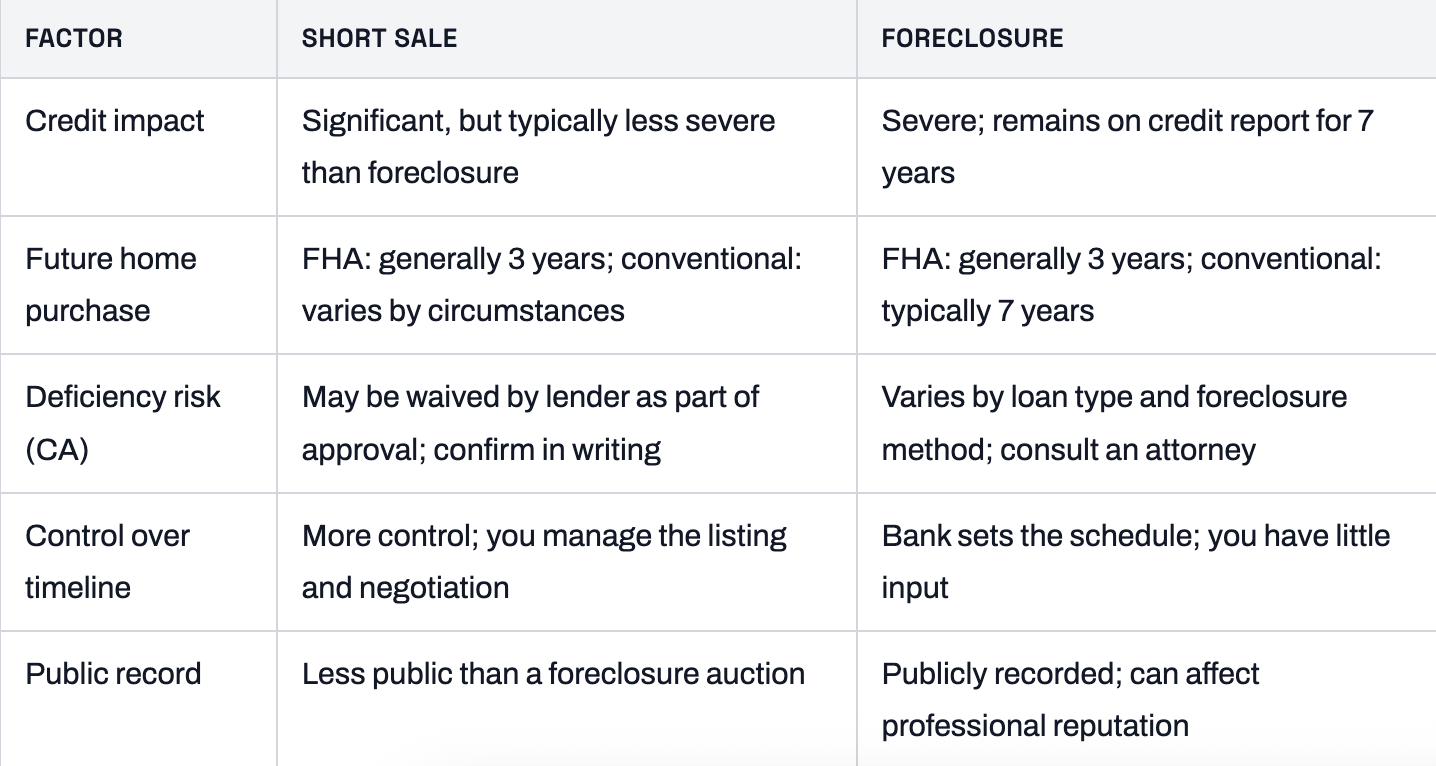
The credit and waiting-period figures above are general guidelines based on Fannie Mae selling guide and FHA program guidance, your specific situation depends on your loan type, servicer, and circumstances. Verify the current waiting periods with your lender before making decisions based on them.
On the deficiency question: California has specific anti-deficiency protections depending on the loan type and how the foreclosure proceeds, but those rules are complex and fact-specific. If you're concerned about what you might still owe after a short sale, talk to a California real estate attorney before you sign anything. This is one area where a general blog answer isn't enough.
What About Closing Costs in a Short Sale?
Closing costs in a short sale follow the same general categories as a standard sale, title insurance, escrow fees, recording fees with the Riverside County Clerk-Recorder, prorated property taxes, and any applicable HOA transfer fees. The difference is that the lender reviews the net proceeds and may approve, reject, or negotiate the cost structure as part of their approval. What gets paid, and by whom, is ultimately subject to lender sign-off. Broker compensation is fully negotiable and not set by law, there is no standard or fixed rate. Any compensation arrangement is agreed in the listing agreement and reviewed as part of the lender's net-proceeds analysis. Every situation is different, and the only way to understand your actual numbers is to run them with someone who knows this market and can communicate directly with your servicer.
Frequently Asked Questions
Can I sell my house in Temecula if I owe more than it's worth?
Yes. You can sell through a short sale, where your lender agrees to accept less than the full payoff and releases the lien so the transaction can close. It requires lender approval and more documentation than a standard sale, but it's a real option that many Temecula Valley homeowners have used to exit a difficult situation without going through foreclosure.
What is a short sale in California?
A short sale is a transaction structure used when the sale proceeds aren't enough to cover the mortgage balance and closing costs. According to the Consumer Financial Protection Bureau, the lender must agree to accept the shortfall and release the lien before the sale can close. The home still lists and sells on the open market, the lender just has to review and approve the deal before it's final.
Will my lender approve a short sale if I'm current on payments?
Possibly, but it depends on your servicer, loan type, and the hardship you can document. Lenders are not required to approve a short sale for current borrowers, but many will consider it with a credible hardship file. If your loan is backed by FHA, VA, Fannie Mae, or Freddie Mac, there are specific workout guidelines that govern your options, contact your servicer directly or consult a HUD-approved housing counselor through the HUD counselor locator.
How long does a short sale take in Riverside County?
Longer than a standard sale. The listing and buyer-acceptance phase can move at normal market pace, in Temecula, homes are currently selling in a median of 28 days, but lender review adds significant time on top of that. The CFPB notes that review timelines vary by servicer and loan type, so there's no universal answer. Budget for the process to take several months from list to close, and more if your servicer has a heavy review queue or requests additional documentation.
Do I still owe the mortgage balance after a short sale in California?
Not automatically. Whether the lender can pursue you for the remaining balance (called a deficiency) depends on your loan type, the foreclosure method, and what the lender agrees to in the short-sale approval letter. California has anti-deficiency protections in certain situations, but the rules are fact-specific. Get the lender's deficiency waiver in writing as part of the approval, and consult a California real estate attorney to understand your exposure before you proceed.
Does a short sale hurt my credit more than foreclosure?
Generally, no. Both a short sale and a foreclosure cause significant credit damage, but most credit experts and lender guidelines treat a foreclosure more harshly than a short sale. Conventional loan waiting periods after a foreclosure are typically longer than after a short sale, depending on the circumstances. The exact impact on your credit score and future borrowing ability depends on your full credit profile, review the current guidelines with a lender before making this decision.
The Bottom Line
Being underwater doesn't mean you're out of options. With a median sale price of $775,000 and homes moving in under 30 days, the Temecula Valley market is active enough that a well-priced short sale can attract real buyers. The process is more involved than a standard listing, but it's manageable with the right team and a clear game plan from the start.
I've walked clients through distressed sales, standard equity sales, and everything in between across Temecula, Murrieta, Winchester, and the surrounding communities. If you're not sure whether you're actually underwater, or you know you are and want to understand your options, let's talk before anything else happens. A conversation costs nothing, and it might change what you think is possible.
Schedule a consultation with Andrew Lewis at Performance Real Estate.
About Andrew Lewis
Andrew Lewis is a top-producing REALTOR® and founder of Performance Real Estate, serving the Temecula Valley and greater Riverside County. Licensed since 2012, he has closed over 500 transactions totaling more than $200 million in sales, specializing in luxury homes, listings, new construction, relocation, and investor-focused real estate.
Real Broker · (951) 237-0292
Equal Housing Opportunity. Andrew Lewis, CA DRE, Performance Real Estate DRE 01914085 / 02022092, Real Broker, licensed by the California Department of Real Estate. This article is general information only and does not constitute legal, tax, or financial advice. Confirm your specific numbers and options with your attorney, tax advisor, lender, or escrow officer before making any decisions.