By Andrew Lewis
Staging can help Temecula Valley homes sell faster and attract stronger offers, but the ROI depends on your home's price point, condition, and whether it's vacant or occupied. Vacant homes, higher-price listings, and properties with dated finishes benefit most. For occupied starter homes in good condition, targeted partial staging often makes more sense than full staging.
Is staging worth it when selling a house in Temecula Valley?
Staging can help Temecula Valley homes sell faster and generate stronger buyer interest, but it's not a guaranteed return for every property. The homes that benefit most are vacant listings, higher-price homes, and properties with awkward layouts or dated finishes. Whether staging belongs in your prep budget depends on your specific price band, condition, and how your home compares to active competition right now.
Here's the honest answer I give sellers who ask me this question: staging is a probability tool, not a guarantee. The right question isn't "Does staging always pay?" It's "Does my home, in this condition and price range, stand to gain enough from staging to justify the cost?"
Most of the time, the answer is yes for vacant homes and a qualified yes for occupied homes above the entry-level price point. Let me walk you through why.
What the Data Actually Says About Staging
The Temecula Valley market is competitive. Recent Zillow market data shows a median sale price of $770,000, with homes sitting on the market a median of 30 days. There are currently 509 active listings competing for buyers, and roughly 400 homes have sold in the last 90 days. In a market with that kind of inventory, how your home looks online and in-person on day one matters enormously.
According to research from the National Association of REALTORS®, staging consistently shortens time on market and improves buyer appeal, though the effect varies by property type and local conditions. NAR's homebuyer research also shows that online listing photos are among the most useful tools buyers use when evaluating homes, which means staging directly affects the first impression that drives showing requests.
That NAR data is national. The local angle matters more. In my experience working with sellers across Temecula, Murrieta, Winchester, and the master-planned communities in this corridor, the homes that generate the strongest first-week activity are the ones that photograph well and show clean. Buyers in this market are often comparing three or four similar homes in the same price band, sometimes in the same community. Presentation is a tiebreaker.
The California Association of REALTORS® market data tracks Southwest Riverside County monthly, and the segment-level picture is important here: this market is not uniformly a seller's market across all home types and price points. Staging ROI is segment-specific. A turnkey three-bedroom in Wolf Creek at $650,000 competes differently than a dated custom home at $950,000 in Morgan Hill. The staging calculus is different for each.
The Vacant Home Case Is the Strongest
If your home is vacant, staging is almost always worth serious consideration. Empty rooms photograph poorly, make it hard for buyers to understand scale and function, and feel cold during showings. A buyer walking into a bare 2,200-square-foot two-story in Harveston often can't visualize how the furniture fits. That uncertainty slows decisions.
Full staging on a vacant home solves that problem directly. It answers the buyer's unspoken question: "Can I actually live here?" That's especially true for homes with open floor plans, great rooms, or non-standard room configurations, which are common in the master-planned communities throughout this valley.
Occupied Homes: Partial Staging Is Usually the Move
For occupied homes, full staging is rarely necessary. What typically moves the needle is focused, partial staging of the rooms that appear most in listing photos and drive the most showing traffic: the living room, kitchen, primary bedroom, and any outdoor entertaining space. In Temecula Valley, that indoor-outdoor connection matters. A well-presented back patio or covered California room can be a real differentiator.
If your existing furniture is dated, oversized, or arranged in a way that makes rooms feel smaller than they are, bringing in a stager for even a partial refresh is worth the conversation. Before you get there, though, consider whether lower-cost prep like paint and minor repairs should come first. I've written about inexpensive pre-sale bathroom updates that often deliver strong visual impact for less investment than staging alone.
Which Temecula Valley Homes Benefit Most (and Least)
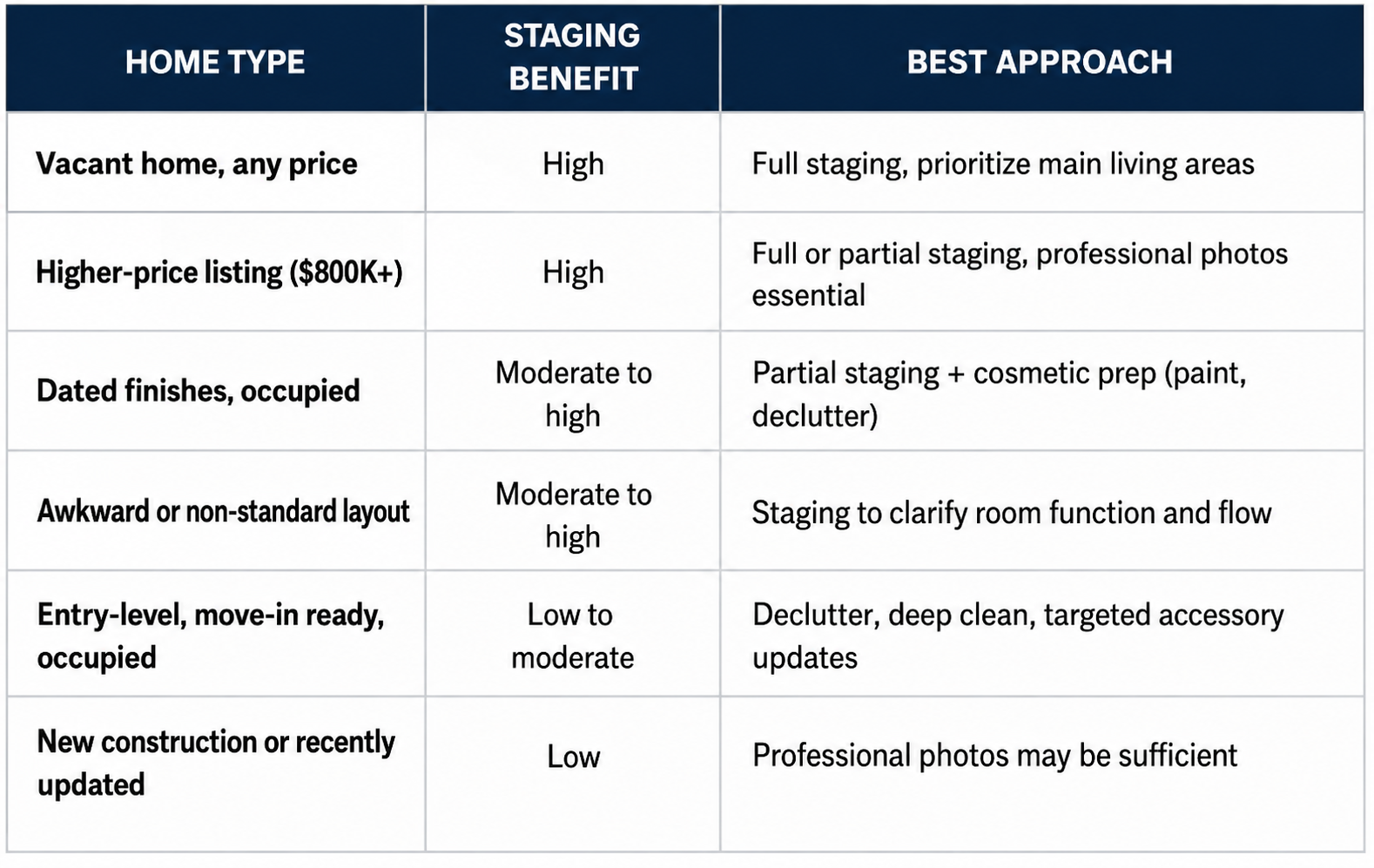
Not every home needs the same approach. Here's how I think about it by property type.
Master-planned communities like Redhawk, Harveston, Paseo Del Sol, and Temeku Hills tend to reward light, modern staging that emphasizes flow and indoor-outdoor living. Buyers in those neighborhoods are often comparing multiple homes in the same tract, so anything that makes yours feel more livable and move-in ready is an advantage. Older or custom homes, where room function isn't obvious, often need heavier staging to reduce visual friction.
Getting clarity on where your home falls in this spectrum is exactly the kind of conversation I have with every seller before we decide on a prep budget. Your specific situation, condition, and the current competition in your price band all factor in.
One Thing Staging Can't Do
Staging improves presentation. It does not substitute for condition, repairs, or disclosure. California law requires sellers to provide a Transfer Disclosure Statement disclosing known material facts about the property, and in parts of Riverside County where wildfire or natural hazard exposure is relevant, a Natural Hazard Disclosure is also part of the transaction. A beautifully staged home with undisclosed issues will surface problems in inspection and create bigger headaches later. Staging works best when it's paired with clean disclosures and a home that's been properly prepped, not used to mask deferred maintenance.
I always tell sellers: get a game plan up front. Know what you're disclosing, know what you're repairing, and then decide how staging fits into the remaining budget. That order matters.
Virtual Staging: A Useful Tool With Real Limits
Virtual staging (digitally adding furniture to photos of an empty home) has improved significantly and is now widely used for vacant listings. It's less expensive than physical staging and can make online photos more compelling. The limitation is the showing experience: a buyer who books a tour based on virtually staged photos walks into an empty house, which can feel like a disconnect.
For listings where budget is tight, virtual staging for the online photos combined with a few key physical pieces (a dining table, a bed frame, a sofa) for showings can be a reasonable middle path. Whether that makes sense for your home is a conversation worth having before you commit to either approach.
Temecula Valley buyers are also influenced by commute access and lifestyle factors when they're comparing homes, according to the City of Temecula and Riverside County community data. That means a home that photographs as move-in ready and lifestyle-aligned has a real edge over one that requires imagination. Staging is one of the most direct ways to close that gap.
Frequently Asked Questions
Does staging help sell a house faster in Temecula Valley?
It can, especially for vacant homes and properties with dated finishes or non-standard layouts. NAR's national staging research consistently shows staged homes tend to spend less time on market, and in a Temecula Valley market where the median days on market is currently around 30 days, a strong first week of showings matters. Staging improves online photos and in-person impressions, both of which drive early activity.
Is staging worth it for a vacant house in Temecula?
Yes, vacant homes are the strongest candidates for staging in almost any market. Empty rooms make it harder for buyers to judge scale and function, and they photograph poorly. Full staging on a vacant Temecula Valley home helps buyers visualize living there, which typically translates to more showings and stronger offers. The investment is more justifiable the higher the price point.
Should I stage a starter home or only higher-end listings?
Higher-price listings have more to gain from full professional staging because the cost is a smaller percentage of the sale price and buyer expectations are higher. For entry-level or starter homes in good, move-in-ready condition, deep cleaning, decluttering, and targeted cosmetic updates often deliver comparable results at lower cost. The key is matching the prep investment to the price band and the condition gap you're trying to close.
How does staging compare with painting or minor repairs for ROI?
In most cases, I'd prioritize condition prep (paint, minor repairs, cleaning) before staging, because no amount of furniture arrangement fixes a buyer's concern about deferred maintenance. Fresh neutral paint and clean, repaired surfaces make staging more effective and are often the higher-ROI move on their own. The two work best together: condition prep first, then staging to maximize presentation. See my notes on low-cost bathroom updates before selling for a practical starting point.
What parts of a home should I stage first if my budget is limited?
Focus on the rooms that appear most in listing photos and matter most to buyers: the living room, kitchen, primary bedroom, and any outdoor entertaining space. In Temecula Valley's master-planned communities, the indoor-outdoor connection is a real selling point, so a well-presented patio or California room can be worth including. Skip staging secondary bedrooms and utility spaces if budget is tight.
The bottom line: staging is a probability tool, not a guarantee, and the homes most likely to benefit are vacant listings, higher-price properties, and homes where presentation is currently working against the price you're trying to achieve. Your specific situation determines whether it belongs in your prep budget, and the only way to know for sure is to run through the numbers and the competition with someone who knows this market.
If you're preparing to sell in Temecula, Murrieta, Winchester, or anywhere in the Temecula Valley, I'm happy to walk through your home's prep priorities and give you an honest read on where staging fits. Schedule a consultation and we'll build a plan that makes sense for your home and your timeline.
About Andrew Lewis
Andrew Lewis is a top-producing REALTOR® and founder of Performance Real Estate serving the Temecula Valley and greater Riverside County. Licensed since 2012, he has closed over 500 transactions totaling more than $200 million in sales, specializing in luxury homes, listings, new construction, relocation, and investor-focused real estate.
Real Broker · (951) 237-0292
Equal Housing Opportunity. Andrew Lewis, CA DRE license information available upon request. Brokerage: Performance Real Estate DRE 01914085 / 02022092, Real Broker. Regulated by the California Department of Real Estate. This article is general information only and does not constitute legal, tax, or financial advice. Confirm all costs, disclosures, and transaction details with your attorney, tax advisor, lender, or escrow officer.