Both Hemet and Winchester offer genuine investor opportunities in Riverside County. Hemet shows documented population, income, and employment growth through 2024. Winchester sits in a competitive southwest Riverside County corridor with a median sale price around $639,000 and strong pending activity. Neither market guarantees returns without property-level underwriting.

Is Hemet or Winchester a good real estate investment in 2026?
Both Hemet and Winchester offer genuine investor opportunities in Riverside County, but they are not the same market. Hemet for investors means working with an established city that has verified five-year growth in population, employment, and income. Winchester is an unincorporated community in the competitive southwest Riverside County corridor, where recent MLS data shows a median sale price around $639,000 and strong buyer demand. Neither market produces automatic returns, the outcome depends entirely on the specific property, your financing, and how you underwrite the deal.
Key Takeaways
Winchester's median sale price sits at $639,000 as of October 2026, based on recent local market data covering the trailing 90 days.
Hemet's population grew 8.9% and median income rose 57.9% between 2019 and 2024, according to the City of Hemet's 2026 Economic Intelligence Report.
In the April 2026 Southwest Riverside County report, 52% of Winchester homes sold above asking price, a signal of compressed inventory and active buyer competition at that time.
Hemet and Winchester serve different investment strategies: Hemet's established housing stock suits long-term rental and renovation plays; Winchester's newer subdivisions attract buy-and-hold investors tracking corridor appreciation.
No publicly available source establishes a guaranteed cap rate, cash-on-cash return, or appreciation rate for either market, every deal requires property-level underwriting.
What does the Winchester investment market actually look like right now?
Winchester sits inside the southwest Riverside County growth corridor, and the numbers reflect that. Recent local market data shows a median sale price of $639,000, with homes averaging 41 days on market and 251 active listings across the area. That is a meaningful pool of inventory, but 80 new listings came to market in just the last 30 days, so the pipeline is moving.
Earlier in 2026, the picture was even tighter. The April 2026 South Inland Empire housing report put Winchester's median sold price at $645,235, with only 24 median days on market and 2.0 months of inventory, squarely in sellers' market territory. That same report found that 52% of homes sold above asking price, and 54% of confirmed sales included a buyer concession averaging $23,300. Those two facts together tell you the market is competitive at the offer stage but sellers are still leaving room to negotiate on terms.
By the June 2026 Southwest Riverside County MLS report, which covers resale single-family residences with three or more bedrooms priced below $800,000, excluding new construction and 55-plus communities, Winchester showed a $671,295 median sold price, 18 active listings, and 51 pending contracts. That pending-to-active ratio is notable. More homes under contract than actively listed is a classic undersupply signal.
One important note: the April and June figures use different time periods, samples, and methodology filters. I wouldn't draw a straight trend line between them without running the underlying MLS data. What they do confirm, consistently, is that Winchester is not a slow market.
How does Winchester compare to nearby areas?
Context matters when you're evaluating where to deploy capital. Here's how Winchester stacks up against other southwest Riverside County markets based on recent local market data:
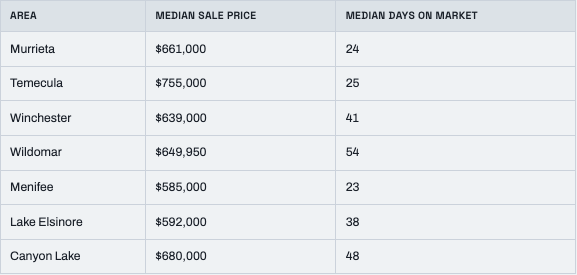
Winchester comes in below Temecula and Murrieta on price, which is exactly why it draws investor attention. You're buying into the same corridor at a lower entry point. The 41-day median is longer than Menifee or Murrieta, which can work in your favor during due diligence, but it also reflects that buyers here are being more deliberate. If you want a deeper look at what different price points actually buy in Winchester, my post on what $600K, $700K, $800K, and $1M buys in Winchester walks through it in detail.
Winchester is also an unincorporated community, which matters for investors. HOA obligations vary significantly by subdivision, and new construction competition is real. Any underwriting that ignores those two factors is incomplete.
What makes Hemet for investors a different conversation?
Hemet for investors starts with a different set of fundamentals than Winchester, and that shapes which strategies make sense. Hemet is an incorporated city with its own planning and economic development infrastructure, and the data coming out of that infrastructure is worth paying attention to.
The City of Hemet's 2026 Economic Intelligence Report documents the five-year period from 2019 to 2024. The headline figures: population up 8.9%, employment up more than 10%, median income up 57.9%, and housing units up more than 10%. Those are structural demand drivers, not marketing language. A market where incomes are rising faster than population is a market where residents can absorb higher rents, and that matters for buy-and-hold investors.
The same report notes a 5.9% overcrowding rate in Hemet, compared to 7.7% for Riverside County overall. Lower overcrowding relative to the county suggests Hemet's housing supply has kept pace better than many surrounding areas, but it also means there's still underlying demand for additional units. Investors exploring accessory dwelling units (ADUs) or multi-unit conversions should factor this in, though any specific project needs to clear city planning and zoning review.
Hemet for investors also means working with an established housing stock. You'll find a wider range of property ages, conditions, and price points than in Winchester's newer subdivisions. That creates more room for renovation-based strategies, but it also means more thorough inspection and repair-cost analysis before you close. The entry price points tend to be lower, which can improve cash-on-cash return projections, but only if the operating costs pencil out. Property taxes, insurance, property management, vacancy, and maintenance don't disappear because the purchase price is attractive.
For a fuller picture of what the market looks like in Hemet before you commit capital, the community context that shapes tenant demand and long-term hold decisions is worth understanding on the ground, reach out and I'll walk you through it.
What investment strategies fit each market?
These are not interchangeable approaches. Here's how I think about the strategic fit for each area:
Winchester: Newer construction, corridor appreciation play, buy-and-hold targeting renters drawn to the Temecula-Murrieta job and amenity base. New construction competition means your rental pricing needs to account for what a tenant could get in a brand-new unit down the street. HOA fees where present reduce net operating income, verify them before you model anything.
Hemet: Longer hold periods, value-add through renovation or ADU addition, potentially lower entry prices with more upside if the income and employment growth trends continue. The 57.9% median income increase documented in the city's report suggests the tenant pool has more purchasing power than it did five years ago. That doesn't guarantee rent levels, it's a demand indicator, not a cap-rate calculator. The case for Hemet for investors is strongest when you're buying a specific property whose numbers work at today's price, not when you're betting on a trend alone.
For a comparable look at how a neighboring market approaches the same investor questions, my post on Menifee growth and real estate investment opportunities covers the Menifee corridor in depth.
Your specific numbers, what a deal actually returns after taxes, financing, vacancy, and repairs, depend on the individual property. That's where a local market analysis and a candid conversation about your hold strategy make the difference between a good investment and an expensive lesson.
FAQ
Is Hemet or Winchester better for real estate investment in 2026?
They serve different strategies, so "better" depends on your goals. Winchester offers newer housing stock in a competitive corridor with a median sale price around $639,000 and strong pending activity, making it a natural fit for appreciation-focused buy-and-hold investors. Hemet's documented five-year growth in population, income, and employment, per the city's own 2026 Economic Intelligence Report, makes it more suited to value-add, renovation, and longer-term rental strategies. The right answer comes from underwriting a specific property in each market, not from a general comparison.
Is Winchester still affordable for investors compared with Temecula and Murrieta?
Yes, Winchester's median sale price of $639,000 sits below both Temecula ($755,000) and Murrieta ($661,000) based on recent local market data. That gap is the primary reason investors look at Winchester, you're buying into the same southwest Riverside County corridor at a lower entry point. The tradeoff is that Winchester is an unincorporated community with varying HOA obligations and active new construction competition, both of which affect your operating cost model.
What should investors know about new construction and development around Winchester?
New construction is a real competitive factor in Winchester. Newer subdivisions mean your rental or resale product competes directly with brand-new inventory, which can cap rent premiums and affect days on market. The June 2026 MLS report covering Winchester explicitly excluded new construction from its data set, which means the reported figures don't reflect that segment of the market. Before investing in Winchester, verify what new projects are permitted or under construction nearby, and factor that into your rent and exit assumptions.
How do property taxes and operating costs affect an investment in Riverside County?
California property taxes are governed by Proposition 13, which sets the base rate at 1% of assessed value with annual increases capped at 2%, but your total tax bill includes additional assessments, Mello-Roos special taxes (common in newer Riverside County subdivisions), and local bonds that can push the effective rate meaningfully higher. Winchester properties in newer developments frequently carry Mello-Roos obligations. Hemet properties in older neighborhoods often do not, but you'll want to confirm that on any specific parcel. Add insurance, property management, vacancy, HOA fees where applicable, and capital reserves to get to a realistic operating cost picture, and verify all figures with your tax advisor and lender before you close.
How can an investor compare a fix-and-flip with a buy-and-hold property in this market?
The comparison comes down to holding period, financing cost, and exit strategy. A fix-and-flip in Hemet benefits from lower entry prices and a documented income-growth trend that supports end-buyer purchasing power, but you need accurate renovation cost estimates and a realistic resale timeline. A buy-and-hold in Winchester targets corridor appreciation and a tenant base drawn to the Temecula-Murrieta area, but your cash flow depends on what rents actually clear after HOA, taxes, and management. Neither strategy works without property-level underwriting, running comps, pulling permit history, and modeling operating costs for the specific address you're considering.
The bottom line on Winchester and Hemet for investors
Both markets have real investment merit in 2026, but they reward different strategies and require honest due diligence. Winchester's corridor position and competitive demand metrics make it a legitimate buy-and-hold target. Hemet's five-year growth story and lower entry points create room for value-add plays, if the operating costs pencil out on the specific property you're buying.
I work with investors across both markets and across the broader Temecula Valley. If you want to run the numbers on a specific address, or just want a straight conversation about where the opportunity actually is right now, reach out and let's talk.
Schedule a consultation with Andrew Lewis to get a market analysis tailored to your investment criteria.
About Andrew Lewis
Andrew Lewis is a top-producing REALTOR® and founder of Performance Real Estate, serving the Temecula Valley and greater Riverside County. Licensed since 2012, he has closed over 500 transactions totaling more than $200 million in sales, with a focus on luxury homes, listings, new construction, relocation, and investor-focused real estate.
Real Broker · (951) 237-0292
Equal Housing Opportunity. Andrew Lewis, CA DRE, Performance Real Estate DRE 01914085 / 02022092, Real Broker, licensed by the California Department of Real Estate. This article is general information only and is not legal, tax, or financial advice; confirm your specific numbers with your closing agent, tax advisor, and lender before making any investment decision.