Pricing slightly below market in Temecula Valley can generate competing offers and a faster sale, but the risk of leaving money on the table is real. In most cases, pricing at market value, grounded in recent local comparables, produces the best combination of speed and final sale price.
Should you price your Temecula Valley home below market to sell faster?
Pricing slightly below market can generate competing offers and a faster sale in Temecula Valley, but it carries a real risk of leaving money on the table. In most cases, pricing at market value, grounded in the most recent local comparables, produces the best combination of speed and final sale price. Overpriced listings, by contrast, tend to sit, accumulate days on market, and ultimately sell below their original ask after one or more price reductions.
Key Takeaways
Recent local market data shows a Temecula Valley median sale price of $755,000 and a median of 29 days on market, with 384 homes closed in the last 90 days, enough transaction volume to price confidently from comparables.
A TemeculaNow analysis using April 2026 data found a sale-to-list ratio of 100.1% and a median of 25 days on market, meaning well-priced homes were selling at or above ask, not below it.
Overpriced listings in Temecula Valley tend to contribute to DOM figures well above the area median, and repeated price reductions signal to buyers that the seller started too high, inviting lower offers.
Pricing strategy differs meaningfully between Temecula's master-planned tract communities near I-15 and the wine-country estate market, the same approach does not work in both sub-markets.
In a seller-leaning but more balanced 2026 market, aggressive underpricing can still spark multiple offers, but the gap between list price and recent comps needs to be deliberate and narrow, not a guess.
What actually happens when you overprice a Temecula Valley home?
Here's the honest answer: buyers notice immediately, and they wait.
Buyers in 2026 are tracking price history on every major portal. When a home hits the market above where the recent comparables land, serious buyers, especially those who've been watching the market for weeks or months, recognize the gap. Many will skip the showing entirely, assuming the seller isn't realistic yet. They'd rather wait for the price cut than waste time on a negotiation that's going nowhere.
What you're left with is a listing that sits. Days on market accumulate. And once a home crosses certain DOM thresholds, the psychology shifts: buyers start wondering what's wrong with it, not whether they should offer more. That's a hard position to recover from.
According to a TemeculaNow market competitiveness analysis using April 2026 data, Temecula's median days on market was 25, with a sale-to-list ratio of 100.1%. That tells you what well-priced homes are doing. The homes dragging the average up are the ones that started too high.
The mid-2026 Temecula Valley seller environment is reasonably strong, but it's not the pandemic frenzy where buyers chased anything at any price. Inventory is up. Buyers have options. If your list price doesn't align with what the comps support, they'll move on to the next listing.
The National Association of REALTORS® has documented this pattern consistently: overpriced listings generate fewer showings in the critical first weeks, lead to eventual price reductions, and often sell below what a correctly priced listing would have achieved from day one. That national pattern plays out here in Temecula Valley too.
What price reductions actually signal to buyers
A single, well-timed price adjustment, made in the first two to three weeks when a home isn't generating showings or offers, can reset buyer interest effectively. That's a legitimate tool, and I use it when the market tells us the price needs to move.
The problem is the pattern of repeated cuts. When a home has had two, three, or four reductions over 60 or 90 days, buyers read that as confirmation the seller overreached. Instead of competing for the home, they start calculating how far below the new list price they can go. Your negotiating position weakens with every reduction.
This is exactly why getting the price right in the first week matters more than any other single decision in the listing process.
Is pricing below market the right move, or does it just leave money on the table?
This is the question I get most often from sellers, and the answer depends on what you mean by "below market."
A narrow, strategic underpricing, say, listing at or just under the most recent comparable sales to create urgency, can absolutely generate multiple offers and a final sale price that meets or exceeds market value. That's a legitimate strategy in a competitive sub-market with an active buyer pool. A Resideline housing market analysis covering 768 closings over the last six months puts Temecula's median sold price at $720,000, which gives you a reasonable benchmark for what "market" looks like across a range of homes.
But there's a meaningful difference between pricing strategically at the lower edge of a defensible range versus pricing dramatically below the comps hoping for a bidding war. In a more balanced 2026 market, with 493 active listings and rising inventory across the valley, aggressive underpricing doesn't guarantee the same feeding-frenzy response it might have in 2021. If the gap between your list price and recent comparables is too large, you may simply attract buyers who expect a deal, not buyers who compete.
Here's how I frame the three positions for my clients:
Priced at market (the heart of the comps): Most likely to go pending within the area median timeframe, with a sale-to-list ratio near 100%. This is where most well-prepared listings should land.
Priced slightly below market (narrow, intentional): Can generate multiple offers and a final price at or above market value, but requires a genuine read on current buyer demand in your specific sub-market. Works best in higher-activity areas like Murrieta and Temecula proper.
Overpriced (above the comps): Generates fewer showings early, risks accumulating DOM, and often results in price reductions that invite lower offers. The final sale price frequently ends up below what a correctly priced listing would have achieved.
Your specific situation, home condition, location within the valley, current inventory in your price range, and timing, determines which approach makes sense. That's not a decision I'd make without running a detailed comparative market analysis first.
How Temecula Valley sub-markets change the math
Not every part of the valley behaves the same way, and this is where generic pricing advice breaks down.
In master-planned communities near I-15, Wolf Creek, Paseo del Sol, Harveston, there are enough recent tract-home comparables that buyers and their agents price these homes quickly and accurately. A listing that overshoots the most recent closed comp by more than a few percent will face resistance fast, because the data is right there. In these neighborhoods, pricing at or just under the most recent comp is often the move that generates early activity.
Temecula wine country is a different animal. Larger lots, custom features, and fewer recent comparables mean the buyer pool is smaller and more deliberate. Overpricing here creates significant DOM inflation because discretionary buyers in that price range won't chase a number that feels aspirational. They'll wait, or they'll buy elsewhere.
The table below shows recent median sale prices and days on market across the communities I cover, the spread is real, and it matters for how you set your initial list price.
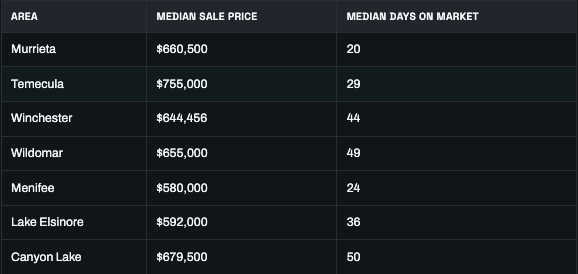
Murrieta's 20-day median and Menifee's 24-day median tell you those markets are moving. Winchester at 44 days and Canyon Lake at 50 days tell you the buyer pool is thinner, overpricing in those areas has a steeper cost. The right pricing strategy for a Winchester home is not the same as the right strategy for a Murrieta tract home, even if the prices are similar.
If you're weighing the broader timing question alongside your pricing decision, the Price Above or Below Market in Temecula Valley post covers the tradeoffs in more depth.
How to figure out the right list price before you commit
The foundation is a comparative market analysis, a detailed look at what homes most similar to yours have actually closed for in the last 60 to 90 days, in your specific micro-neighborhood. Not the wine-country estate two miles away. Not the home on a busy corridor that sold at a discount. The homes that genuinely match yours in size, condition, lot, and location.
From there, I look at active competition (what buyers are seeing right now at your price point), pending sales (where the market is heading), and days on market trends for recently reduced listings (what happens when sellers start too high). That combination tells you where to price with confidence.
A few things I always make sure sellers understand before we set a number:
The first two weeks are everything. Buyer interest peaks immediately after a new listing hits the MLS. That window is when you have the most leverage, don't waste it with a price that pushes serious buyers away.
Online estimates are a starting point, not a strategy. Automated valuations don't account for your home's specific condition, recent upgrades, or micro-neighborhood dynamics. I've seen them miss by $50,000 in both directions on Temecula Valley homes.
Price reductions are recoverable, but costly. If the market tells us in week two that the price needs to move, we move it. But every day you wait after that is a day buyers are forming a negative opinion of the listing.
Your net proceeds depend on the final sale price, not the list price. A home that lists at $800,000 and sells at $760,000 after 75 days on market may net you less than a home that lists at $765,000, sells at $772,000 in 18 days, and closes clean.
Every situation is different, and the only way to know where your home should be priced is to run the numbers with someone who knows this market. That's the conversation I have with every seller before we ever talk about a list price.
Frequently Asked Questions
If I price my Temecula home above market, will buyers still come see it or just wait for a price drop?
Most informed buyers will wait. Buyers in 2026 are tracking price history on the portals, and when a listing comes in above where the recent comps land, experienced buyers recognize it immediately and hold off for a reduction. You may get some early showings from less-informed buyers, but the serious, qualified buyers, the ones most likely to close, tend to skip overpriced listings and revisit after a cut. By then, you've already lost the momentum of your first two weeks on market.
Is it smart to list my Temecula house slightly below market to spark a bidding war?
It can work, but it needs to be deliberate and narrow. In higher-activity sub-markets like Murrieta (median 20 days on market) or Temecula proper (median 29 days), pricing at the lower edge of a defensible comparable range can generate multiple offers and a final sale price at or above market value. The risk is pricing too far below the comps in a more balanced 2026 market, you may attract buyers expecting a deal rather than buyers competing for the home. A strategic underpricing of a few percent is very different from a dramatic discount.
How long do Temecula homes sit on the market when the seller starts too high and then cuts the price?
It varies, but the pattern is consistent: homes that start above the comps and go through one or more price reductions often end up well above the area median days on market before going pending. Recent local market data shows a Temecula median of 29 days on market, but overpriced listings with price-reduction histories can sit two to three times longer before finding a buyer. The longer the DOM, the more negotiating leverage shifts to the buyer, and the more likely the final sale price lands below what a correctly priced listing would have achieved.
Do Temecula buyers think something is wrong with a home if the price keeps getting reduced?
Yes, and that perception is hard to shake. A single, well-timed price adjustment in the first two to three weeks can reset buyer interest effectively. But repeated cuts, two, three, or more reductions over 60 or 90 days, signal to buyers that the seller overreached, and buyers respond by making more aggressive offers below the new list price rather than competing for the home. The price-reduction history is visible on every major portal, and buyers use it.
What's the best pricing strategy for Temecula wine-country homes versus tract homes near I-15?
They require different approaches. Tract homes in master-planned communities near I-15 have abundant recent comparables, so buyers and their agents price them quickly and accurately, overshooting the most recent closed comp by more than a few percent will face resistance fast. Wine-country and estate homes have fewer comparable sales, larger lot sizes, and more custom features, which means the buyer pool is smaller and more deliberate. Overpricing in the wine-country market creates significant days-on-market inflation because discretionary buyers won't chase an aspirational number. The right strategy depends on a detailed CMA specific to your sub-market.
Are Temecula buyers in 2026 still paying over asking, or do they expect negotiating room?
Both happen, and which one applies to your listing depends almost entirely on how it's priced. A TemeculaNow analysis using April 2026 data found a sale-to-list ratio of 100.1%, meaning well-priced homes were selling at or slightly above ask. Homes that are priced correctly and show well are still generating competing offers in active sub-markets. Homes that start high and reduce are inviting buyers to negotiate below the new list price. The difference is the initial pricing decision, not the market.
The bottom line: in Temecula Valley's 2026 market, pricing at market value, grounded in the most recent local comparables for your specific sub-market, gives you the best shot at a fast sale and a strong final price. Whether a slight underpricing makes sense for your home depends on your neighborhood, your timeline, and current buyer demand in your price range. That's a conversation worth having before you commit to a number.
If you're trying to figure out where your home should be priced, I'll pull the comps, walk you through what the market is telling us, and give you a honest read on what strategy makes sense for your situation. Reach out to schedule a consultation, no pressure, just data.
About Andrew Lewis
Andrew Lewis is a top-producing REALTOR® and founder of Performance Real Estate, serving the Temecula Valley and greater Riverside County. Licensed since 2012, he has closed over 500 transactions totaling more than $200 million in sales, specializing in luxury homes, listings, new construction, relocation, and investor-focused real estate.
Real Broker · (951) 237-0292
Equal Housing Opportunity. Andrew Lewis, CA DRE, Performance Real Estate DRE 01914085 / 02022092, Real Broker, licensed by the California Department of Real Estate. This article is general information only and is not legal, tax, or financial advice. Confirm your specific costs and proceeds with your closing agent, tax advisor, or lender. Broker compensation is fully negotiable and not set by law.