Buying a home in Temecula Valley requires more upfront cash than just the down payment. Budget for closing costs, inspection and appraisal fees, prepaids, and lender-required reserves. With a median sale price near $757,000, total out-of-pocket cash can be substantial, exact amounts depend on loan type, lender, and negotiated terms.
How much cash do you actually need to buy a home in Temecula Valley?
Buying a home in Temecula Valley requires more cash upfront than most buyers expect. Beyond the down payment, you'll need to cover closing costs, inspection and appraisal fees, prepaid expenses like homeowner's insurance and property tax prorations, and lender-required cash reserves. With the current median sale price in Temecula sitting at $757,000, even a modest down payment percentage translates into a significant cash commitment, and that's before you add everything else.
Key Takeaways
The median sale price in Temecula is $757,000 as of September 2026, based on recent local market data, meaning even a 10% down payment requires $75,700 before closing costs, prepaids, or reserves.
A June 2026 analysis reported that the typical homebuyer down payment in the Riverside, CA metro was roughly 10% of the purchase price, though buyers can use loan programs that allow less.
Buyer cash requirements fall into four distinct buckets: down payment, closing costs, prepaids, and post-closing reserves, each with different timing and different levels of negotiability.
In Riverside County, the documentary transfer tax is customarily a seller cost, which means most Temecula buyers can focus their cash planning on lender fees, escrow, title, and prepaids rather than that tax line.
As of Q2 2026, there were 2,746 down payment assistance programs nationwide, with about 62% available to first-time buyers, and some California programs offer up to $10,000 in closing cost assistance for eligible buyers.
What are the four cash buckets every Temecula buyer needs to plan for?
Most buyers think of the down payment as the whole upfront cost. It's the biggest piece, but it's not the whole picture. I walk every buyer I work with through four distinct cash buckets before we write a single offer.
1. Down payment
Your down payment is the portion of the purchase price you pay out of pocket, the rest is covered by your mortgage. The right amount depends on your loan type, your lender's requirements, and your financial goals.
A June 2026 analysis from Redfin found that the typical homebuyer down payment in the Riverside, CA metro was roughly 10% of the purchase price. That's a useful benchmark, but it's not a floor. FHA loans allow as little as 3.5% down for qualifying buyers, and VA loans can require zero down for eligible veterans. Conventional programs through Fannie Mae and Freddie Mac offer options as low as 3% for first-time buyers who qualify.
At the current Temecula median of $757,000, here's what different down payment percentages look like in dollar terms:
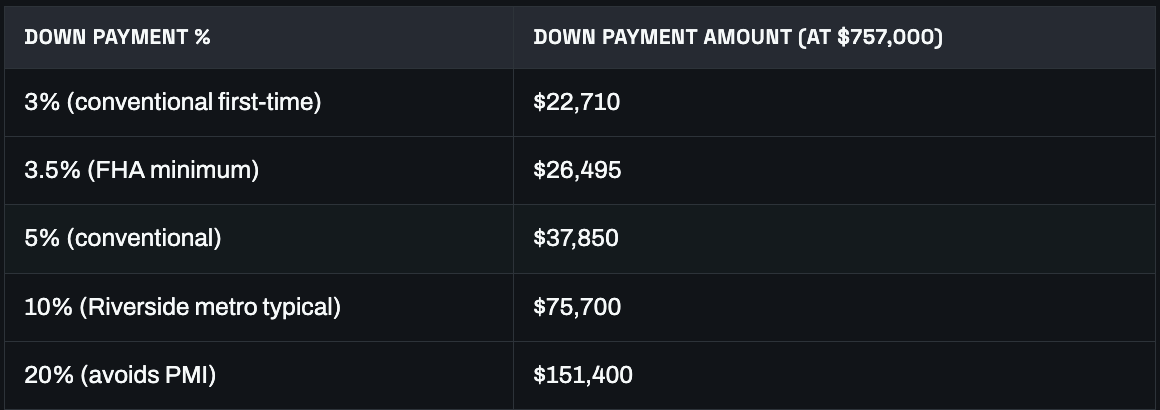
These are down payment figures only. The total cash you need to bring is higher once you add the other three buckets.
2. Closing costs
Closing costs are the fees and charges due at settlement, separate from your down payment. In California, the CFPB's Closing Disclosure breaks these into lender charges, third-party fees, and prepaid items. For Temecula Valley buyers specifically, the categories to plan for include:
Lender fees: Origination, underwriting, document prep, and appraisal charges set by your lender.
Escrow fees: In Riverside County, local custom is that escrow fees are split 50/50 between buyer and seller, but this is negotiable, not required by law.
Lender's title insurance policy: Protects your lender's interest in the property. The buyer typically pays this in Riverside County practice.
Recording fees: Charged by the Riverside County Recorder to record the deed and deed of trust.
Third-party reports: Natural hazard disclosure reports, HOA transfer and setup fees if applicable.
One cost you generally don't need to budget for as a buyer in Temecula: the Riverside County documentary transfer tax. The county charges $1.10 per $1,000 of the sale price, and local custom is that the seller pays it. Temecula and Murrieta also don't add a separate city transfer tax on top of that, unlike some other California jurisdictions. That said, in a competitive offer situation, a buyer could agree to cover or split that cost to strengthen their offer, your agent should flag when that makes sense.
Because closing costs are driven by lender, loan type, and negotiated terms, the only way to know your actual number is to get a Loan Estimate from your lender and review it with someone who knows this market.
3. Prepaids
Prepaids are often the most underestimated piece of the cash puzzle. These are expenses you pay at closing that aren't fees, they're real costs you'd pay anyway, just collected upfront.
Homeowner's insurance: Most lenders require the first year's premium paid at or before closing.
Prepaid interest: Interest that accrues from your closing date to the end of that month.
Property tax prorations: California property taxes are billed in two installments. At closing, you'll pay a prorated share depending on where in the tax cycle you close.
Impound (escrow) account funding: If your lender requires an impound account, which many do, you'll fund it at closing with several months of property taxes and insurance as a cushion.
Prepaids can add a meaningful amount to your total cash requirement. The exact figure depends on your closing date, your insurance premium, and your property's tax assessment. This is another reason to run your numbers with a lender early, not the week before you want to make an offer.
4. Cash reserves
After you close, most mortgage programs require that you still have money left in the bank. These are called cash reserves, and lenders verify them before funding your loan.
According to Down Payment Resource's Q2 2026 report, many conventional programs require two to six months of PITI (principal, interest, taxes, and insurance) in verified reserves, with higher requirements for riskier profiles or non-owner-occupied properties. Some first-time buyer programs for primary residences may have lower reserve requirements or waive them entirely for strong borrower profiles.
The practical point: don't drain every dollar you have to make the down payment and cover closing costs. If your lender requires two months of reserves and you don't have them after closing, your loan can be denied at the finish line. I've seen buyers get this far and hit that wall, it's an avoidable problem if you plan for it upfront.
What does cash timing look like once you're under contract in Temecula?
The total cash number matters, but so does when each piece is due. Here's how the cash flows out during a typical Temecula Valley transaction:
Immediately after offer acceptance
Your earnest money deposit is due within a few business days of offer acceptance under standard California purchase agreements. It's held in escrow and credited back toward your down payment and closing costs at closing, so it's not an additional cost, it's a timing issue. You need that cash liquid and accessible the moment your offer is accepted.
The deposit amount is negotiable. A stronger deposit can signal commitment to the seller, but the right amount depends on the price point and market conditions. I'll give you a clear recommendation based on the specific property and what the seller is likely to respond to.
During the inspection and loan period
Your home inspection fee is paid directly to the inspector, typically within the first week or so after mutual acceptance. This is an out-of-pocket cost paid before closing, and it's non-refundable even if you cancel based on what the inspection reveals. The same applies to the appraisal fee, which is usually collected by your lender when the appraisal is ordered.
These costs are modest compared to the down payment, but they're real cash you need available early in the process, before you know whether the deal will close.
At closing
The remainder of your down payment, closing costs, and prepaids are due at closing, typically wired to escrow. Your closing agent will provide a final Closing Disclosure that itemizes every dollar. Verify it against your earlier Loan Estimate and flag any discrepancies before you wire funds.
Are there programs that can reduce how much cash Temecula buyers need?
Yes, and more buyers qualify than realize it. As of Q2 2026, Down Payment Resource tracked 2,746 down payment assistance programs nationwide, with about 62% (roughly 1,696 programs) available specifically to first-time homebuyers.
California has its own state-level programs, including CalHFA, which offers down payment and closing cost assistance to eligible buyers. According to The Mortgage Reports' 2026 California first-time buyer guide, some programs provide up to $10,000 in closing cost assistance for qualifying buyers, in addition to down payment help.
These programs come with income limits, purchase price caps, and sometimes geographic restrictions. They also change, a program that was available six months ago may have different terms or funding today. The only way to know what you actually qualify for is to talk to a lender who actively works with these programs in Riverside County. I can connect you with local lenders who know this landscape well.
How do prices across Temecula Valley affect your cash planning?
Temecula Valley isn't one uniform market. Prices vary meaningfully across the communities I cover, and that directly affects how much cash you need. Here's a current snapshot based on recent local market data (trailing roughly 90 days, as of September 2026):
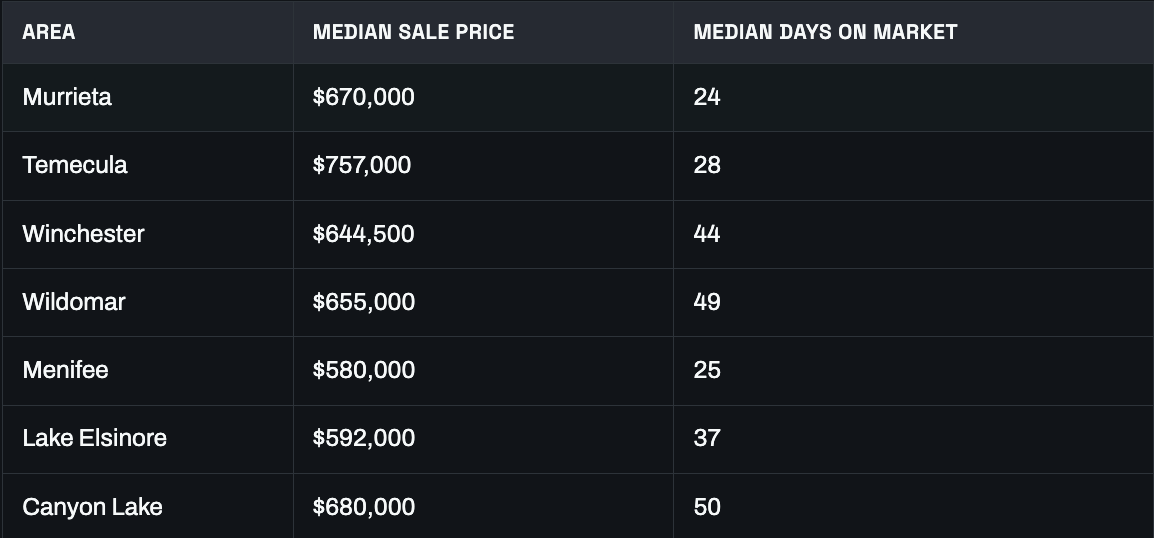
A buyer targeting Menifee at a $580,000 median is looking at a very different cash requirement than one targeting Temecula at $757,000, even with the same loan type and down payment percentage. These are area-level medians; any individual home's price depends on condition, street, build year, and timing. But they give you a real starting point for your cash planning conversations with your lender.
If you're weighing which community fits your budget, the full picture of what daily life looks like across Temecula Valley is worth understanding before you commit to a price point and a neighborhood.
Frequently Asked Questions
What closing costs do Temecula homebuyers pay, and which ones does the seller usually cover in Riverside County?
Buyers in Temecula Valley typically pay lender fees (origination, underwriting, appraisal), their share of escrow fees, the lender's title insurance policy, recording fees, and prepaids. In Riverside County, local custom is that the seller pays the documentary transfer tax and the owner's title insurance policy, while escrow fees are split. These allocations are negotiable, not required by law, and your agent will frame them clearly when structuring your offer.
Is the transfer tax in Temecula something the buyer pays, or does the seller usually cover it?
In Riverside County, the documentary transfer tax is customarily paid by the seller. The county rate is $1.10 per $1,000 of the sale price, and neither Temecula nor Murrieta adds a separate city transfer tax on top of that. Buyers can agree to cover or split this cost to strengthen a competitive offer, but in standard transactions it's a seller-side line item.
How big does my earnest money deposit need to be, and when is it due?
Earnest money deposit amounts are negotiable and vary by price point and market conditions, there's no fixed rule. Under standard California purchase agreements, the deposit is typically due within a few business days of offer acceptance and is held in escrow until closing, where it's credited toward your down payment and closing costs. It's not an extra cost; it's cash you need liquid immediately after your offer is accepted.
Are there first-time buyer or down payment assistance programs that can help with closing costs in Temecula or Murrieta?
Yes. California's CalHFA program and various other assistance programs can help eligible buyers with both down payment and closing costs. As of early 2026, some California programs offered up to $10,000 in closing cost assistance for qualifying first-time buyers. Eligibility depends on income, purchase price, and program availability at the time you apply, a local lender who works with these programs is the right starting point.
How much in cash reserves do lenders typically want after closing on a Temecula home?
Most conventional loan programs require two to six months of PITI (principal, interest, taxes, and insurance) in verified reserves after closing, with the exact amount depending on your loan type, credit profile, and property type. Some first-time buyer programs for primary residences have lower requirements or waive them for strong borrowers. Reserve requirements are set by lenders and investors like Fannie Mae, FHA, and VA, not California law, so confirm your specific requirement with your lender early in the process.
Can I buy a home in Temecula with less than 10% down?
Yes. While a June 2026 analysis showed the typical Riverside metro buyer put down roughly 10%, that's a behavioral average, not a requirement. FHA loans allow 3.5% down for qualifying buyers, VA loans can require zero down for eligible veterans, and some conventional programs go as low as 3% for first-time buyers. The right down payment amount depends on your loan type, lender guidelines, and how you want to balance upfront cash against monthly payment and mortgage insurance costs.
The bottom line: the cash you need to buy a home in Temecula Valley is the sum of your down payment, closing costs, prepaids, and post-closing reserves, and each piece has different timing and different levels of negotiability. Getting clarity on all four buckets before you start making offers makes the whole process less stressful and keeps you from being surprised at the finish line.
My team covers the full Temecula Valley, Temecula, Murrieta, Menifee, Winchester, Wildomar, Lake Elsinore, Canyon Lake, and Hemet. If you're getting ready to buy and want to work through your real cash number before you start shopping, reach out and let's put together a game plan. And if you're a first-time buyer who wants to avoid the most common missteps, the first-time buyer guide for Temecula is a good next read.
About Andrew Lewis
Andrew Lewis is a top-producing REALTOR® and founder of Performance Real Estate serving the Temecula Valley and greater Riverside County. Licensed since 2012, he has closed over 500 transactions totaling more than $200 million in sales, specializing in luxury homes, listings, new construction, relocation, and investor-focused real estate.
Real Broker · (951) 237-0292
Equal Housing Opportunity. Andrew Lewis, CA DRE, Performance Real Estate DRE 01914085 / 02022092, Real Broker. Regulated by the California Department of Real Estate. This article is general information only and does not constitute legal, tax, or financial advice; confirm your specific costs and loan terms with your closing agent, tax advisor, or lender.